
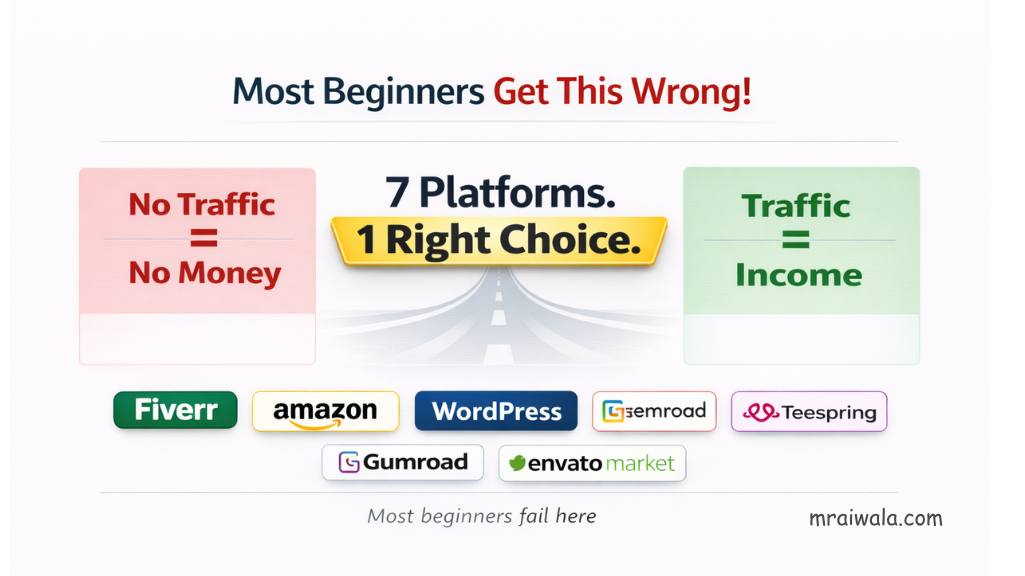
I stopped keeping a list of platforms I was “going to try” to make money online for beginners.
At one point, that list had eleven items. Substack. Skillshare. Ko-fi. Redbubble. A few others I don’t even remember. Every few weeks, I’d add something new after reading a post titled exactly like this one. The list felt like progress. It wasn’t. It was a way to avoid choosing.
Deleting it was uncomfortable, not liberating. The options collapsed into one, and one felt risky.
If You Only Remember One Thing From This Guide
- No traffic → no income. Platform is irrelevant.
- Need money fast → service work (Fiverr)
- Building long-term → content (Blog + Affiliate)
- No audience yet → avoid Gumroad and Teespring entirely
Everything else in this guide is details around these four lines.
The Real Problem Isn’t Effort. It’s Orientation.
You’ve probably already tried something. Made a Fiverr profile. Started a blog, wrote four posts. Created a product on Gumroad and refreshed the dashboard for two weeks.
Nothing happened. And the question you’re carrying now isn’t “how do I work harder.” It’s closer to: am I even on the right path?
They list platforms, add ratings, and say “great for beginners!” without ever asking what beginners actually bring to the table. Which is usually: time, unstable effort, and no reliable way to reach people.
The honest answer depends on one thing most people aren’t thinking about. Not your skill.
Your traffic source.
There are only two ways money comes online:
- Platform sends you traffic → you convert (Fiverr, Etsy, Envato)
- You bring traffic → platform pays you (Blog, Gumroad, Affiliate)
Every confusion about platform choice disappears once you understand which side you’re starting from. This is the mental model. Everything else follows.
Beginners don’t fail because platforms don’t work. They fail because they switch before the platform starts working.
4 Filters That Actually Matter
1. Earning Potential: Not what the top earner made. What does someone with six months of real effort, average skill, and no existing audience typically earn?
2. Time to First Income: Six months with zero rupees is psychologically different from two weeks with two hundred.
3. Traffic Source: Does the platform bring you buyers, or do you bring the platform buyers?
4. Skill Match: What do you actually have right now?
Run each platform through these, and the decision stops being about which one is “best.” It becomes about which one fits your actual situation.
Common Mistakes Worth Naming
Ignoring traffic while obsessing over the product. Every person who failed after three months of effort failed here. They built a decent service or product and had no answer to the question: how will anyone find this? The real work is getting seen. The platform is just where you get paid.
Starting multiple platforms simultaneously. This feels like diversification. It’s dilution. Four mediocre presences instead of one that actually works.
Example: Beginner Path (No Skill, No Audience)
This is what a realistic start looks like, not a success story, just a path with honest timing.
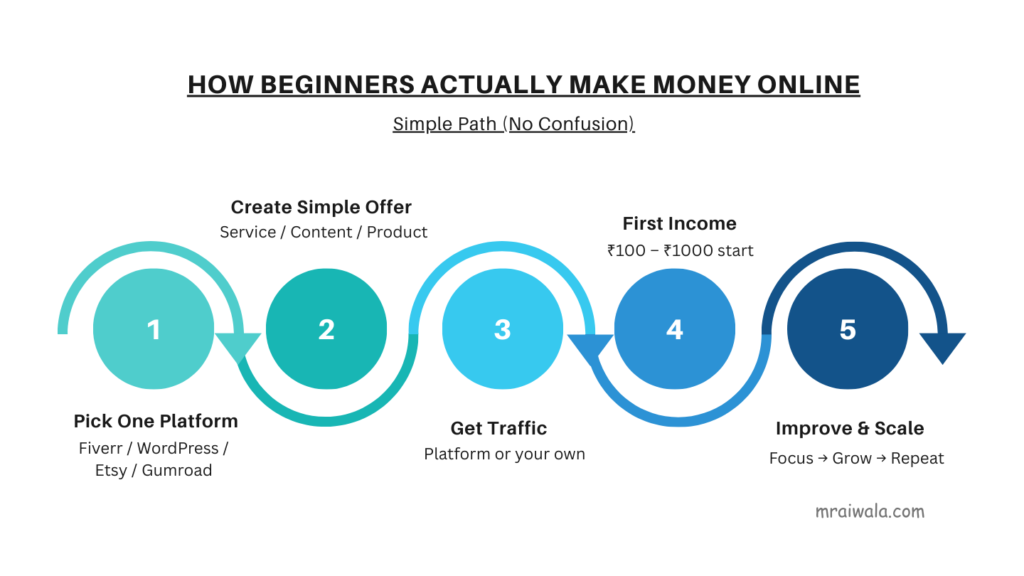
Week 1: Create a Fiverr gig around the most basic thing you can do. Data entry. Proofreading. Formatting documents. The skill doesn’t need to be impressive; it needs to be specific and deliverable.
Week 3: First order. Maybe ₹300–₹500. The amount doesn’t matter. The proof matters that someone found you, trusted you enough to pay, and you delivered.
Month 2: With 2–3 completed orders and a decent response time, Fiverr’s algorithm starts showing your gig more. Realistic income: ₹3,000–₹5,000/month. Still small. Still real.
Month 4: You now know what buyers actually ask for. You narrow your gig to one specific type of request. You raise your price. Conversion improves because specificity builds trust faster than variety.
This isn’t exceptional. It’s what consistent, unglamorous effort on one platform looks like. Most people abandon in month two, which is exactly when the algorithm was about to notice them.
Platform Breakdown
1. Fiverr
Fiverr is a marketplace where buyers search for specific services. You create a gig, Fiverr surfaces it, and buyers order. In practice, the surfacing part takes weeks before the algorithm trusts a new account enough to show it to anyone meaningful.
| Factor | Reality |
|---|---|
| Earning Potential | ₹5,000–₹50,000/month realistic at 6 months |
| Entry Difficulty | Low no approval, but positioning matters |
| Time to First Income | 2–8 weeks |
| Scalability | Low rates can increase, but it stays service work. |
| Skill Match | Writing, design, video editing, voice-over, translation |
| Traffic Source | Platform-assisted, after initial traction |
| Competition Level | High in generic categories, lower in specific sub-niches |
| Control and Risk | Medium account ban risk is real. |
What actually decides success here:
- Niche clarity, not skill level. A narrow gig outperforms a broad one almost always.
- First 5 reviews momentum trigger. Getting these is the only goal in month one.
- Response speed: Fiverr’s algorithm actively rewards fast replies. Under one hour, when possible.
Hidden Costs
20% commission per order, always. Time spent on revisions and client messages, some days an hour of communication earns nothing. Budget for both mentally before starting.
Best for: Someone with a demonstrable skill, willing to narrow their positioning, patient enough to wait 4–6 weeks before seeing traction.
2. Amazon Associates
You recommend products through content. Someone clicks your link and buys. You earn a 1%–10% commission, depending on the category. The math only works with reach × conversion × order value, which means this is a slow-build model, not a fast-income one.
| Factor | Reality |
| Earning Potential | ₹5,000–₹40,000/month, realistic at 12 months |
| Entry Difficulty | Low to get approved. Hard to build reach. |
| Time to First Income | 3–6 months minimum from zero |
| Scalability | High old content compounds |
| Skill Match | Writers, bloggers, YouTube creators |
| Traffic Source | Entirely you |
| Competition Level | High in obvious categories, lower in specific long-tail niches |
| Control and Risk | Medium Amazon has cut commission rates before |
What actually decides success here:
- Search intent match writing about what people are actively searching to buy, not just what interests you.
- Topical depth covering one product category thoroughly outperforms random product mentions across unrelated topics.
- Patience past month three, this is when most people quit. It’s also when Google starts trusting new content.
Hidden Costs
Time 4–8 hours per quality article. Hosting: ₹200–₹500/month. A basic SEO tool to identify what people actually search for.
Best for: Someone with writing ability and a genuine 12-month horizon. Not suitable as a fast-income option.
3. WordPress (Blogging)
A self-hosted WordPress blog is the only platform on this list where you own everything. You write content, rank on Google, monetize through ads, affiliate links, sponsored posts, or your own products. Slowest start. Highest ceiling.
| Factor | Reality |
| Earning Potential | Near zero for 6 months. ₹15,000–₹1,00,000/month at 18–24 months with focused effort. |
| Entry Difficulty | Medium setup is manageable; SEO is the real challenge. |
| Time to First Income | 3–6 months, often longer |
| Scalability | Very old posts keep earning. |
| Skill Match | Writers, researchers, and people with domain expertise |
| Traffic Source | Almost entirely SEO |
| Competition Level | High broadly. Real room in specific sub-niches. |
| Control and Risk | Highest of all platforms, you own the content. |
What actually decides success here:
- Consistency over months, not days, publishing 30 posts in month one and nothing in month three is worse than 8 steady posts per month for a year.
- Niche depth: A blog that covers one specific topic thoroughly will always outrank a blog that covers many topics loosely.
- Google’s trust timeline for new domains takes 4–6 months minimum to gain traction in search. This isn’t negotiable.
Hidden Costs
Domain: ₹700–₹1,000/year. Hosting: ₹150–₹600/month. SEO tool. Budget ₹3,000–₹5,000 to set up and ₹1,000–₹2,000/month ongoing.
Best for: Someone with writing ability, genuine interest in a specific topic, and a real 12–24 month timeline.
Start your blog in minutes with no setup hassle.
I use Hostinger, simple, beginner-friendly.
Start your blog →
4. Gumroad
Gumroad lets you sell digital products, such as eBooks, templates, Notion dashboards, PDF guides, presets, and mini-courses. Create once, sell repeatedly. The model is genuinely compelling. The catch: Gumroad brings you nothing. No discovery, no buyers. You bring everything.
| Factor | Reality |
| Earning Potential | Unpredictable without an audience. ₹10,000–₹50,000/month possible with 500+ engaged followers. |
| Entry Difficulty | Very low technically. Hard without an existing audience. |
| Time to First Income | Weeks to never, depending on your reach |
| Scalability | Very high one product, unlimited sales |
| Skill Match | Creators, designers, and educators with an existing following |
| Traffic Source | Entirely you |
| Competition Level | Irrelevant, no real discovery mechanism on the platform |
| Control and Risk | Hi, you own the product and customer list. |
What actually decides success here:
- Existing audience, however small, even 300 engaged followers change the math entirely.
- Product validation before building, ask before creating. One DM asking “Would you pay ₹299 for X?” tells you more than 40 hours of building.
- Specificity of the product is a guide that solves one specific problem for one specific person. A general guide for everyone sells to no one.
Most Gumroad products don’t fail because they’re bad. They fail because nobody knew they existed.
Hidden Costs
Time to create something genuinely useful: 20–100 hours, depending on the product. Transaction fees on every sale.
Best for: Someone who already has a small but engaged audience and wants to monetize through a digital product.
5. Etsy
Etsy is a marketplace for handmade, vintage, and digital goods. For online earners, the real opportunity is digital downloads, Canva templates, printables, planners, social media kits, and SVG files. Upload once, sell the same file repeatedly.
| Factor | Reality |
| Earning Potential | ₹5,000–₹40,000/month is realistic at 6–12 months for a focused shop |
| Entry Difficulty | Low- to medium-level setup is simple; standing out is harder. |
| Time to First Income | 4–12 weeks |
| Scalability | Medium-high, more listings increase visibility. |
| Skill Match | Designers, Canva users, and visually creative people |
| Traffic Source | Mixed Etsy search + external promotion |
| Competition Level | High in popular categories. Real room in specific sub-niches. |
| Control and Risk | Medium Etsy can suspend shops; fees are rising. |
What actually decides success here:
- Etsy SEO in titles and tags “Wedding Template” gets buried. “Boho Watercolor Wedding Invitation Canva Template Editable” gets found.
- Design quality relative to your niche is not world-class, but visibly better than what’s ranking below you.
- External promotion in the early days of Pinterest and niche Facebook groups drives first sales before Etsy’s algorithm trusts your shop.
Hidden Costs
Listing fees ($0.20 per listing, renewed every 4 months). Transaction + payment processing fees stack. Canva Pro (₹3,999/year) is practically necessary for creating templates that convert.
Best for: Someone with design ability willing to build a product library steadily over 6–12 months.
6. Teespring (Now Spring)
Print-on-demand. You upload a design; it goes on a t-shirt, mug, or hoodie; someone orders; Spring prints and ships it. You earn the margin. No inventory. No upfront cost.
| Factor | Reality |
| Earning Potential | ₹2,000–₹15,000/month with active promotion. Rarely more without serious reach. |
| Entry Difficulty | Very low technically. Demand creation is the hard part. |
| Time to First Income | Varies from weeks to never |
| Scalability | Medium more designs + better reach = more sales |
| Skill Match | Graphic designers who understand specific niches and trend cycles |
| Traffic Source | Almost entirely external |
| Competition Level | Low on the platform. High in the broader print-on-demand space. |
| Control and Risk | Medium thin margins, dependent on platform pricing |
What actually decides success here:
- Community access: You need to be inside or connected to the niche you’re designing for.
- Trend timing designs that tap into current cultural moments sell. Generic designs don’t.
- Promotion discipline without an active push, uploads sit invisible permanently.
Hidden Costs
Design tools. Paid ads, if used, can easily exceed earnings until a winning design surfaces.
Best for: Someone with design skills and an existing niche community. Not a good starting point from zero.
7. Envato Market
Envato is a marketplace for creative assets, including WordPress themes, HTML templates, PowerPoint templates, After Effects projects, Photoshop files, and audio. You build a high-quality asset, survive their review process, get approved, and earn royalties on every sale. One good template can sell for years.
| Factor | Reality |
| Earning Potential | Highly variable popular items: ₹50,000–₹2,00,000/month. Most items earn very little. |
| Entry Difficulty | High-quality bars are strict, and rejection is common. |
| Time to First Income | 1–3 months, including review and ranking time |
| Scalability | Very high for popular items |
| Skill Match | Web developers, UI/UX designers, motion designers, audio producers |
| Traffic Source | Platform-driven |
| Competition Level | High-top items have dominated for years. |
| Control and Risk | Medium non-exclusive authors keep rights; exclusive authors earn more but are locked in. |
What actually decides success here:
- Differentiation from existing top sellers is not just quality, but a specific gap the current top item doesn’t fill.
- Multiple submissions, the first rejection is normal. Second- and third-submissions with refinements usually fare better.
- Choosing the right sub-category, some Envato categories are oversaturated. Others have real room. Research before building.
Hidden Costs
Time is the dominant cost. Building a quality WordPress theme or After Effects project can take weeks or months. That investment comes entirely before any income.
Best for: Someone with genuine technical or creative expertise, willing to invest significant time building at a professional quality level.
All Seven Platforms Compared
| Platform | Time to First Income | Passive Potential | Traffic Source | Ideal for Beginners? |
| Fiverr | 2–8 weeks | Low | Platform-assisted | Yes, if you have a clear skill |
| Amazon Associates | 3–6 months | High | Entirely you | Yes, with a long horizon |
| WordPress | 3–6 months | High | Entirely you | Yes, with a long horizon |
| Gumroad | Unpredictable | Very High | Entirely you | No need for an existing audience |
| Etsy | 4–12 weeks | Medium | Mixed | Yes if design-skilled |
| Teespring | Unpredictable | Low-Medium | Entirely you | No need for an existing audience |
| Envato | 1–3 months | Very High | Platform-driven | Only with strong technical skills |
Quick Start Guide
- No skill yet, need income now → Fiverr (learn while earning)
- Writing ability + patience → WordPress + Amazon Associates
- Design skill + consistency → Etsy
- Audience already exists → Gumroad
- Advanced technical or creative skill → Envato
Set a first income target of ₹1,000. Not ₹10,000. Not ₹1 lakh. The first ₹1,000 shows you where the real friction is, what buyers actually respond to, where your positioning is off, and what you hadn’t accounted for.
Match your platform to your actual situation, not your ideal one. Zero social following, zero email subscribers, zero SEO knowledge, you need a platform with built-in reach. Fiverr or Etsy. Not Gumroad. Not Teespring.
Start your blog in minutes with no setup hassle.
I use Hostinger, simple, beginner-friendly.
Start your blog →
Recommendation
Need income within 60 days: Fiverr. Create a specific gig in a defined sub-niche. Send 5–10 buyer requests daily for the first two weeks. Don’t undercut your pricing; it signals inexperience more than affordability.
Building for 12–24 months: WordPress with Amazon Associates. Write consistently. Learn enough SEO to understand search intent. The older your content gets, the more it earns.
Have a product idea and some audience: Gumroad. Validate before you build. Ask your audience what they’d pay for. Start with the smallest version that actually solves the problem.
What This Guide Still Doesn’t Solve
Every framework here assumes you know which skill you’re monetizing.
A lot of people reading this don’t. They’re reasonably good at several things. Not exceptional at any one thing, obviously. They’ve read enough to know “find your niche” is the advice, and they’re exhausted by it because they’ve tried and come up mostly blank.
That problem is upstream of everything in this guide.
You still have to figure out the what before the where. There isn’t a cleaner way around it. It comes from attempting something specific, noticing what the attempt reveals, and adjusting from there, not from reading more comparisons.
The platform question is real. But it’s the second question, not the first.
And that first question, what do I actually have to offer, stays open. Even after choosing a platform. Even after the first income. Sometimes, especially then.
The platform doesn’t decide your income. Your ability to stay on one long enough does.
Related Posts📌
7 Best Data Science Books for Beginners to Master the Basics (2026)
5 AI Freelance Jobs From Home That Actually Pay $400–$600/Month

