
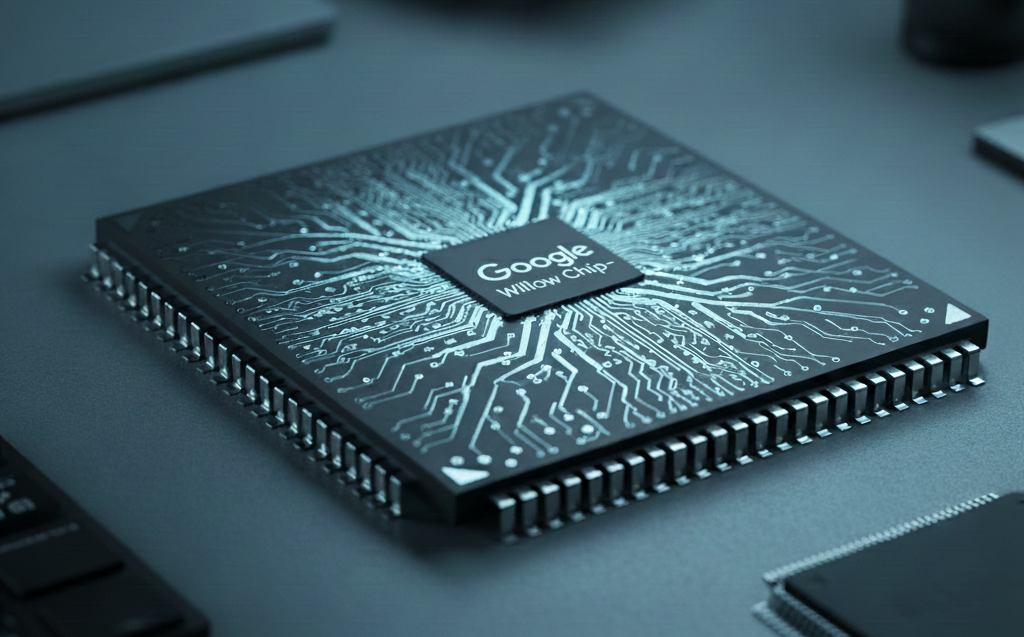

The Error-Rate Reversal That Collapses Time (Expanded Deep Chapter)
There is a reason most people misunderstood what actually happened with the Google Willow chip.
The reason is simple.
They were trained to look for speed.
Decades of computing progress have conditioned us to ask the same lazy question again and again:
“How much faster is it?”
But the Willow breakthrough has almost nothing to do with speed in the way we usually understand it.
It has to do with something far more fundamental.
Trust.
And trust, once earned, does something far more dangerous than acceleration.
It collapses time.
Not metaphorically.
Not philosophically.
But structurally inside how science, research, and decision-making actually function.
The One Rule That Killed Quantum Computing Again and Again
Every complex system obeys a quiet, unforgiving rule.
As scale increases:
• Interactions multiply
• Noise compounds
• Stability becomes harder to maintain
This rule doesn’t care about intention or brilliance.
It applies everywhere.
Cities collapse under coordination overload.
Organizations rot under communication friction.
Software systems break under dependency sprawl.
Biological systems fail when regulation falls behind growth.
Quantum computers were no exception.
In fact, they suffered from this rule more brutally than almost any technology before them.
Because quantum systems are not just complex.
They are fragile by nature.
They exist in a state that the universe itself is constantly trying to destroy.
Why Quantum Errors Are Fundamentally Different
In classical computing, errors are boring.
A bit flips from 0 to 1.
Memory glitches.
A packet drops.
Annoying? Yes.
Fatal? Rarely.
Classical errors are:
• Local
• Detectable
• Correctable after the fact
You can log them.
Patch them.
Re-run the program.
Quantum errors are different at a structural level.
They are:
• Distributed across the system
• Often invisible until measurement
• Capable of destroying information entirely
A quantum error doesn’t politely raise its hand and say, “Something went wrong.”
It silently contaminates the computation.
And once that happens, you don’t just get a wrong answer.
You lose the meaning of the answer.
This is why early quantum machines felt unsettling even to world-class engineers.
You could do everything “right”
Follow every protocol
Stabilize every parameter
And still get nonsense.
Not because you failed but because the system betrayed you.
The Scaling Curse That Made Quantum Look Like a Dead End
Before Willow, the relationship looked cruelly simple:
More qubits →
More interactions →
More noise →
More correction overhead →
Less usable computation
Every attempt to scale made the system:
• More expensive
• More fragile
• Less predictable
Instead of unlocking power, scale punished ambition.
So progress became defensive.
Teams stopped asking the exciting question:
“What new problems can we now solve?”
And started asking the survival question:
“How do we stop this thing from falling apart?”
That shift matters more than it sounds.
Because when a field becomes obsessed with survival, it stops dreaming.
And when it stops dreaming, revolutions quietly die.
Why “Reducing Errors” Was Never Enough
This is where many people still misunderstand Willow.
They think Willow matters because it reduced errors.
That’s not the breakthrough.
Error reduction has been happening for years through better materials, better control systems, better calibration.
The real problem was never error existence.
It was error scaling.
As systems grew, error growth outpaced correction gains.
Linear improvements were fighting exponential fragility.
No matter how hard researchers worked, scale punished them faster.
Until it didn’t.
The Moment the Curve Bent the Other Way
Willow demonstrated something that, until recently, sounded almost heretical:
At a certain scale, error correction became stronger than error creation.
Read that again slowly.
Not equal.
Not barely sufficient.
Stronger.
That single reversal changes everything.
It means:
• Reliability improves as the system grows
• Confidence increases with scale
• Computation becomes composable and repeatable
This is not tuning.
This is not optimization.
This is a phase transition.
Quantum systems cross from fragile experiments into self-stabilizing machines.
The kind of machines you can plan around.
The kind you can trust.
Why This Changes Everything About Time
Here is the part most articles completely fail to explain.
Scientific timelines are not slow primarily because experiments take time.
They are slow because of waiting.
Waiting for:
• Computation
• Verification
• Confidence
• Repetition
Unreliable systems force humans to hesitate.
They force double-checking.
Over-validation.
Endless replication.
Reliable systems remove hesitation.
And once hesitation disappears, time collapses.
Not because clocks run faster but because human indecision disappears.
Logical Qubits: Where Time Actually Disappears
Logical qubits are the quiet heroes of this story.
A logical qubit is not just a qubit.
It is a promise.
A promise that the information you put in will still exist later.
A logical qubit:
• Holds state reliably
• Survives long computations
• Behaves predictably
Before Willow:
• Logical qubits were rare
• Expensive
• Fragile
They existed more as demonstrations than as tools.
With Willow:
• Logical qubits improve with scale
That single fact changes the economics of thinking.
Because when results are trustworthy:
• You don’t rerun endlessly
• You don’t over-validate
• You don’t delay decisions
You decide earlier.
And earlier decisions reshape entire industries.
The Psychological Shift No One Mentions
This is the invisible layer most technical discussions ignore.
When tools are unreliable, people become conservative.
They:
• Hedge ideas
• Avoid bold exploration
• Stick to incremental paths
Not because they lack imagination but because failure is expensive.
When tools become reliable, behavior changes.
Researchers:
• Explore wider solution spaces
• Kill bad ideas early
• Take creative risks
Willow doesn’t just change computation.
It changes how humans behave around uncertainty.
And that behavioral shift compounds faster than any hardware improvement.
This Is Where “Years to Minutes” Actually Comes From
When people say:
“Quantum computers reduce years to minutes”
They imagine faster calculations.
That mental model is wrong.
The real mechanism looks like this:
• Computation becomes trustworthy
• Trust removes waiting
• Waiting removal compresses timelines
The speedup comes from human confidence, not clock cycles.
A drug candidate that used to die after eight years of testing doesn’t die faster because computers are quicker.
It dies earlier because it is eliminated before humans commit years of belief to it.
That difference matters.
Why Time Compression Is Nonlinear
Saving time once is helpful.
Saving time at every iteration changes reality.
Consider drug discovery.
Classically:
• Approximate molecular behavior
• Test in labs
• Fail late
• Repeat slowly
Failure often comes after massive investment financial, emotional, and institutional.
With reliable quantum simulation:
• Eliminate impossible candidates upfront
• Test only viable structures
• Fail early and cheaply
You don’t just save years.
You recover entire alternative futures that were never explored because time made them unreachable.
Energy, Materials, Climate: Same Pattern, Bigger Stakes
Battery research slows because atomic interactions are too complex.
Materials science stalls because simulations lie just enough to mislead.
Climate modeling struggles because systems are nonlinear and deeply entangled.
In all these domains:
• Classical systems guess
• Quantum systems calculate
With Willow-level reliability:
• Dead paths are eliminated before labs are built
• Physical testing becomes confirmation, not exploration
• Policy decisions move earlier
And earlier action is often more valuable than perfect accuracy.
A good decision made early beats a perfect decision made too late.
The Quiet Return of Abandoned Ideas
This is one of the most underappreciated consequences.
Some research paths were abandoned not because they were wrong.
They were abandoned because:
• Computation was too slow
• Failure took too long
• Confidence arrived too late
Time killed them, not logic.
Willow makes failure fast again.
Fast failure is not discouraging.
It is liberating.
It restores curiosity.
And curiosity is the raw fuel of scientific progress.
Why This Is Not “Quantum Supremacy” Theater
This moment is not about beating classical computers on artificial benchmarks.
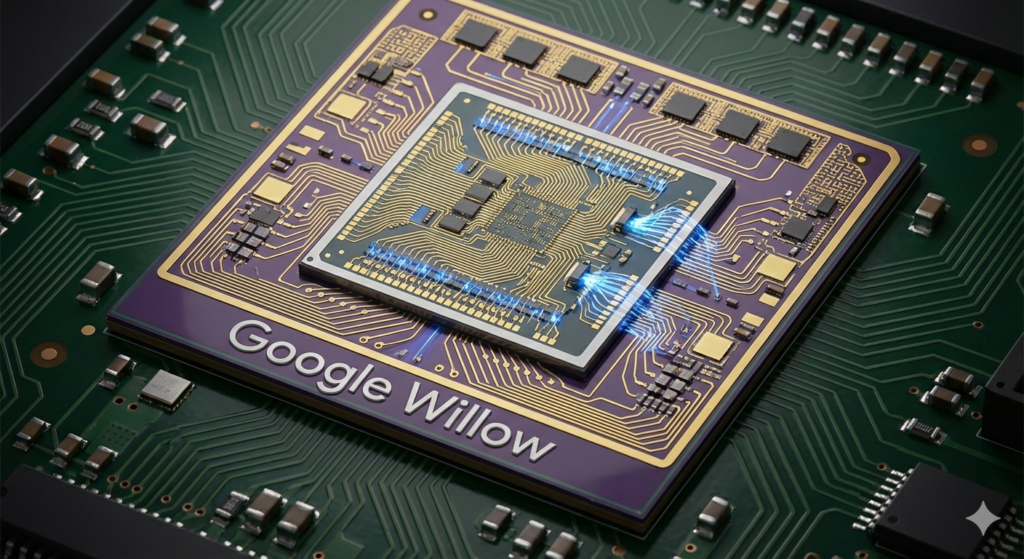
It’s about making certain problems routine.
Routine problems stop being celebrated.
They become infrastructure.
Infrastructure reshapes civilization quietly, without headlines, without applause.
That’s how real revolutions happen.
Predictability: The Real Power Behind the Power
The deepest shift Willow represents is predictability.
Predictable systems:
• Attract long-term investment
• Enable roadmaps
• Justify planning beyond hype cycles
Unpredictable brilliance stays academic.
Predictable competence changes the world.
This is the quantum equivalent of discovering that progress itself can compound.
The Shape of Progress Has Now Changed
Before Willow:
• Progress was fragile
• Scaling was feared
• Breakthroughs were isolated
After Willow:
• Progress becomes continuous
• Scale reinforces stability
• Improvement compounds
This is when exponential curves stop being theoretical and start being operational.
The Uncomfortable Truth About Control
Any system that collapses time creates power.
Those who decide:
• What gets simulated
• What gets optimized
• What gets ignored
Shape reality indirectly.
This is not a dystopian warning.
It is a responsibility.
It means governance, access, and intent matter as much as hardware.
Where This Leaves Us
At this point, several things are now clear:
• Quantum computing stalled for decades because scale destroyed trust
• Willow reverses that rule
• Error-rate reversal collapses waiting, not just computation
• Time not speed is the true currency being unlocked
From here, the question is no longer:
“Can quantum computers matter?”
The question becomes:
“What happens to science, industry, and humanity when waiting stops being the bottleneck?”
If you want to continue, say:
“Continue next merged chapter.”
Next, we’ll move into human, economic, and civilizational consequences
without hype, without fear-bait, and without wasting a single paragraph.
Releted Posts 📌
Human Moral Judgment: The Most Valuable Skill AI Can’t Replace
