
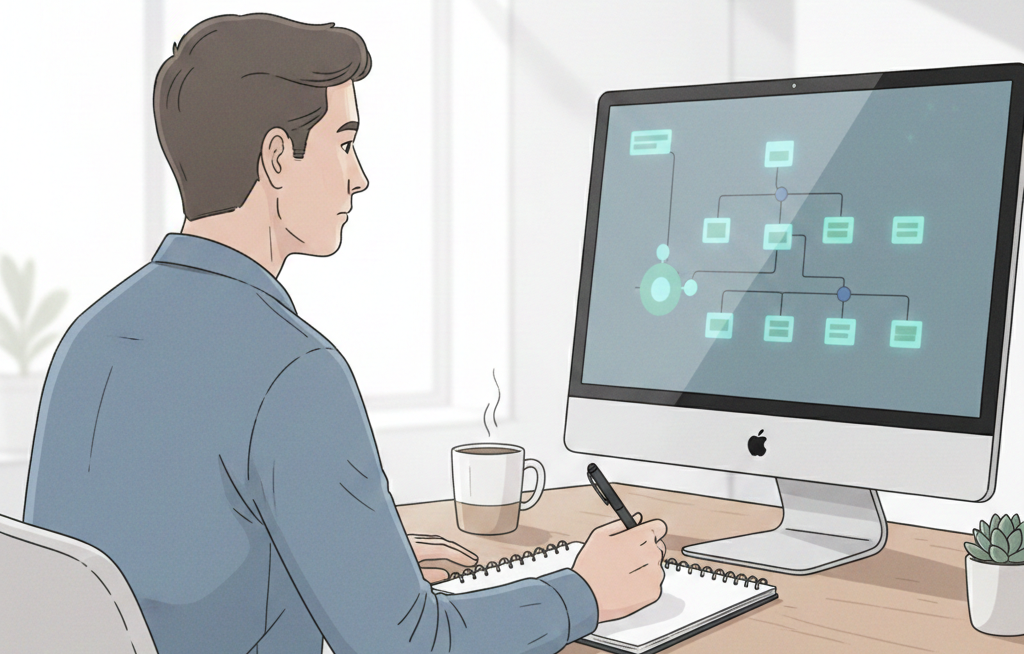

It was late, and my eyes were tired in that specific way that comes from rereading something you already understand. I wasn’t confused. I wasn’t stuck. I just kept circling the same paragraph because something about it felt slightly off. Not wrong. Not broken. Just misaligned.
The AI had done exactly what I asked. It summarized, suggested, and optimized. The answer was clean and confident, the kind of response that makes you feel like thinking any further would be unnecessary. And still, my hand didn’t move.
I hovered over the keyboard, aware of a small resistance that wasn’t emotional or intellectual. It was physical, almost instinctive. A quiet signal that said: if you follow this, whatever happens next belongs to you. The AI will not be there when it does.
That pause is where this entire conversation actually begins.
Why We Start in the Wrong Place
Most discussions about AI begin with capability. Speed. Accuracy. Scale. How much data it can process, how many patterns it can detect, how quickly it can respond. All of that is impressive, and most of it is beside the point.
Real-world decisions don’t usually fail because information was missing. They fail because context was misunderstood, timing was wrong, or responsibility was blurred. They fail when something technically correct produces a human consequence that no one fully accounted for.
That is where AI goes quiet.
The Language of Distance
Listen closely to how people describe AI-driven decisions. The language always creates space.
“The model suggested…”
“The system flagged…”
“The output indicates…”
The grammar itself keeps the speaker one step removed. But when something goes wrong, the sentence structure changes immediately.
“Why did you approve this?”
“Why didn’t you stop it?”
“Why didn’t you think this through?”
Responsibility snaps back to the human without hesitation. Not philosophically, but practically through blame, accountability, and consequence. That snap is the gap most conversations ignore.
Output Is Not Judgment
AI output is not judgment. It comes before judgment.
Judgment is what happens when someone looks at an answer and asks not just whether it is correct, but whether they are willing to stand behind it. Ownership is not a feature you can ship. It’s a burden someone has to carry.
AI generates possibilities. Humans absorb outcomes.
That difference doesn’t disappear, no matter how advanced the system becomes.
Judgment Is Not About Choosing the Best Option
There’s a common misunderstanding that judgment is simply choosing the best or most optimal option. It isn’t. Judgment is choosing an option while fully aware of what breaks if you’re wrong.
AI can calculate consequences. It can rank risks. It can simulate probabilities. But it doesn’t live with the aftermath of a decision. It doesn’t carry the weight of having acted too early, waited too long, or trusted the wrong signal.
Humans do.
A Doctor and a Screen
Consider a doctor using an AI-assisted diagnostic system. The model scans images faster than any human, identifies patterns with remarkable precision, and attaches confidence scores to its conclusions. Technically, it’s extraordinary.
But when the doctor walks into the room and sees a patient waitinganxious, exhausted, trying to read meaning into every facial expression equation changes. The decision is no longer just about statistical accuracy.
It becomes about how much uncertainty this person can handle right now, whether everything should be said at once or in stages, and what happens to this family if the diagnosis is wrong. Those questions don’t exist in the dataset. They emerge only in the presence of another human being.
Human Judgment vs AI Output, Plainly Stated
The difference becomes clear when an actual decision needs to be made.
| Decision Reality | AI Output | Human Judgment |
| Source of action | Generates answers from patterns and data | Chooses actions knowing who will be affected |
| Relationship to risk | Calculates risk statistically | Accepts risk personally |
| Handling uncertainty | Fills gaps with probabilities | Holds uncertainty without rushing |
| Ethical pressure | Applies rules consistently | Breaks or bends rules when responsibility demands it |
| Timing decisions | Optimizes for speed and efficiency | Delays or acts based on human impact |
| After a wrong decision | Moves on to the next output | Lives with consequences and learns from regret |
| Accountability | Has none | Cannot be avoided |
Stripped of theory and hype, the difference is simple.
AI produces answers.
Human judgment absorbs responsibility.
This is not a competition about intelligence. It’s about accountability under uncertainty.
Why Senior People Distrust AI More Than Juniors
There’s a reason junior employees often embrace AI recommendations more enthusiastically than senior ones. Juniors are usually evaluated on correctness. Seniors are evaluated on outcomes.
If your job is to provide the right answer, AI is an advantage. If your job is to live with the consequences of that answerpolitical, financial, or human becomes just one input among many.
Experience doesn’t make people anti-technology. It makes them cautious about what technology doesn’t carry.
Where Automation Actually Works
Automation excels at low-risk, reversible decisions. High-volume actions where mistakes are cheap and correction is easy. Scheduling, sorting, filtering, and optimization at the edges.
As decisions become irreversible when people are affected, resources are exhausted, or harm becomes permanenthuman judgment stops being optional. Not because humans are superior, but because someone must be answerable when there is no reset button.
Accuracy Does Not Replace Judgment
A common question is what happens if AI becomes perfectly accurate. Even then, judgment remains. Accuracy doesn’t tell you when to act, how to communicate a decision, or whether now is the right moment given the human dynamics involved.
Perfect information still requires timing, framing, and moral courage. Those are not computational problems.
The Value of Doing Nothing
One of the least discussed aspects of judgment is deliberate inaction. Sometimes the correct decision is to wait to let information settle, to allow conditions to change, to avoid locking in damage too early.
AI systems are designed to respond. To output. To optimize. Silence is not their natural state.
Humans, when they are paying attention, sometimes choose it deliberately.
Learning Through Regret
AI does not experience regret. It can model risk and predict negative outcomes, but regret is something else entirely. It’s the knowledge that you could have acted differently, and that knowledge reshapes how you decide next time.
AI evolves through data. Humans evolve through consequence. That distinction matters more than we admit.
Why People Try to Outsource Judgment
Many people lean on AI not because they trust it more, but because it creates distance. Distance from blame, from doubt, from the emotional cost of choosing.
This works until accountability arrives. When it does, the distance collapses instantly, and the human is left standing alone with a decision they didn’t fully inhabit.
Ethics Is Not a Rulebook
Ethics isn’t just a set of rules that can be encoded. It’s an ongoing negotiation with reality. Rules help, but judgment is required when rules collide.
Who gets prioritized when resources are scarce? Who carries the risk when someone must? When does mercy matter more than fairness? These are not questions of optimization. They are questions of responsibility.
The Advantage You Can’t Demo
Human judgment doesn’t show up well in demos or benchmarks. It doesn’t fit neatly into charts or slides. It appears only at the moment of commitment, when someone says, implicitly or explicitly, “I’ll stand behind this.”
AI never says that.
The Real Risk
The real risk isn’t that AI will replace human judgment. It’s that humans will stop practicing it. Judgment is a muscle. Delegated too often, it weakens. You begin trusting outputs without interrogating assumptions, mistaking confidence for correctness, and forgetting that systems don’t suffer when things fail.
A Quiet Ending
Late at night, with the room dim and the screen glowing, I sometimes reread an AI-generated answer that is technically flawless. And I still don’t use it right away. Not because it’s wrong, but because it doesn’t feel owned yet.
So I adjust it, delay it, sometimes discard it entirely. Not to prove a point, but to make sure that if this decision echoes later, I recognize my own voice in it.
Eventually, the hesitation lifts not because certainty arrives, but because responsibility does. And that’s usually where I stop. Not finished. Just paused.
Releted Posts 📌
AI Finished the Task, But the Responsibility Was Still Mine
Autonomous Intelligence: AI That Does the Work While Humans Keep the Control

1 thought on “Human Judgment vs AI Output: The Invisible Advantage AI Can’t Replace”