
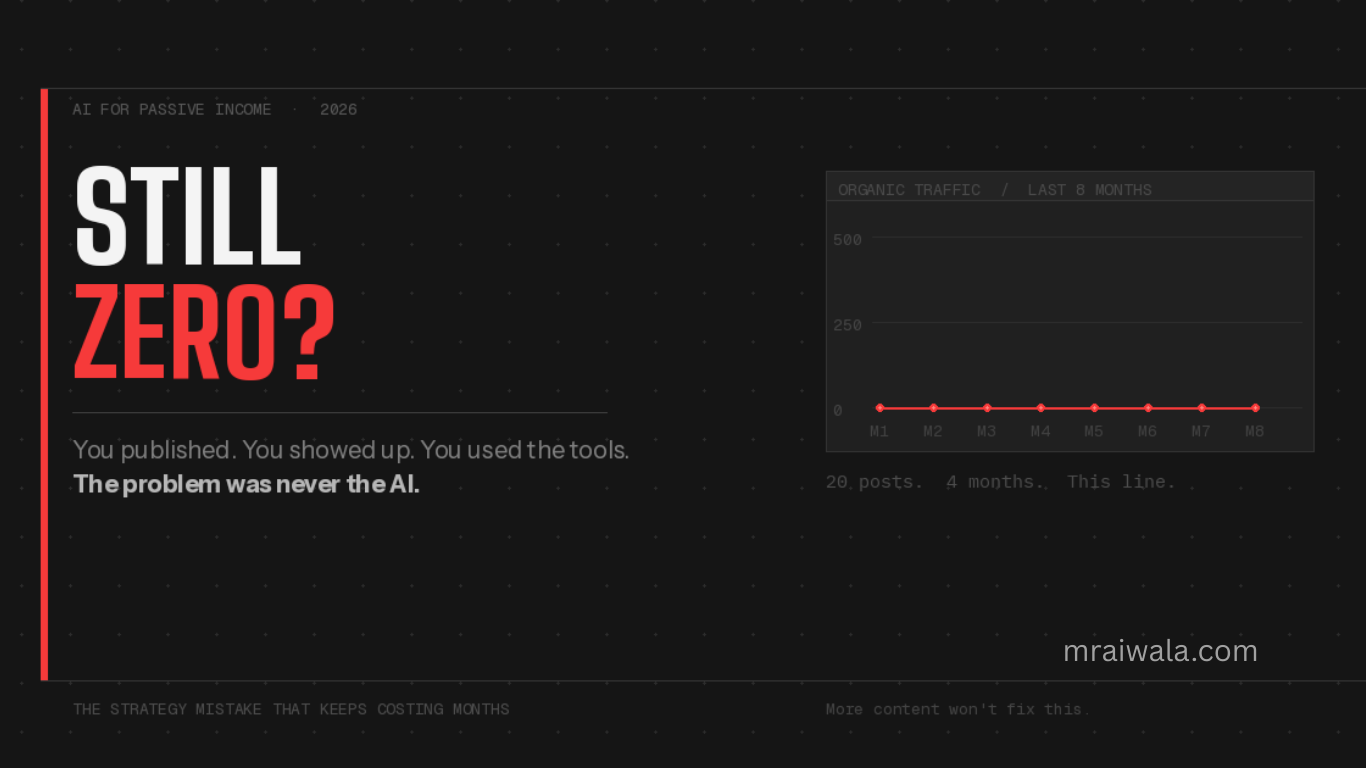

You set up the blog to earn AI passive income. Ran the content through ChatGPT, cleaned it up, and published four or five posts. Did the thing everyone said to do. And then nothing. Maybe $2 from AdSense in two months. Maybe zero.
So you went back to YouTube. Found a new video. Tried a different approach. Downloaded another tool. And somewhere in that loop, you started wondering if this was ever going to work, or if you were just very good at looking busy.
That is where many people are right now. Not beginners. People who have started, done the work, and are staring at a gap between what they expected and what actually happened.
I am going to write this as plainly as I can, because I have been in that gap myself.
The Real Problem Isn’t the Tool
Passive income, stripped down: you do significant work upfront, set up a system, and it generates income with less active involvement over time. The key phrase is significant work upfront.
AI makes that upfront work faster. A blog post that took six hours now takes two. An ebook that took three weeks takes four days. That compression is real.
However, it does not alter the underlying requirement: you still need a distribution channel, an audience, and a reason for people to buy or click. ChatGPT writing your article is AI. Getting 10,000 people a month to read it through search is the business. AI cannot do that part for you.
People operate with the wrong definition: “AI will do everything, and money will keep coming in.” That is a fantasy. AI is a tool. The business model is a separate thing entirely.
The Costly Mistake (This Is the One That Eats Months)
Here is what I see happen most often, and what happened to me in year one.
You find a model that sounds right, say, blogging. You research it, find tools, and start producing content. Fairly quickly, you have a site with twelve posts. You’ve spent $95 on tools, a domain, and hosting. Forty or fifty hours.
The site gets thirty visitors a day, mostly you and some bots.
So you add more content. Twenty posts. Traffic doesn’t move. Maybe finance would be better than cooking. Maybe try YouTube instead. Seven subscribers in three weeks. You come back to the blog.
By month four, you’ve touched three models, mastered none, and the only conclusion you’ve reached is that AI passive income might be over hyped.
It wasn’t. The problem was treating AI as a shortcut and skipping the part where you actually build a strategy.
The mistake is structural, not motivational. You can be consistent and disciplined and still spin in circles if the structure is vague. The structure people skip most often is niche definition and the traffic plan, because they’re not as exciting as content creation.
I’ve watched a friend, smart, disciplined, genuinely good writer, spend eight months on a personal finance blog covering mutual funds, credit cards, crypto, and tax planning. Consistent posting, AI-assisted content, decent writing. Stuck at 200 visitors a month.
The problem wasn’t effort. “Personal finance” as a niche doesn’t rank. It’s dominated by CNBCTV18, ET Money, and Mint sites with domain authority in the hundreds. No room for a new general finance blog.
When he narrowed to credit card rewards optimization for salaried IT professionals in metro cities, things moved within ten weeks.
That shift didn’t require new tools. It required clarity.
The Models That Actually Work Right Now
Four AI-assisted models I’d consider genuinely viable in 2026. Honest about each.
AI-Assisted Blogging
Still works, but the entry bar has risen. Google is better at identifying thin AI content, so blogs that rank now have clear topical authority covering a specific niche deeply, not broadly.
Pick a niche with search volume but low-authority competition, use AI to produce content faster, do proper on-page SEO, build internal links, and wait. Monetize through display ads (Ezoic, Mediavine) or affiliate links.
Time to first income: 4 to 8 months minimum. Investment: $60 to $120 (domain, hosting, basic tools). Where people fail: no keyword research before writing. Thirty posts on topics nobody searches for, then wondering why traffic doesn’t come.
Digital Products
Underrated for Indian creators. Ebooks, templates, prompt packs, Notion dashboards build once, sell repeatedly. AI compresses creation time significantly.
The constraint is distribution. No audience means the product sits in a Gumroad store unseen. You need a social following, an email list, or organic traffic first.
What works: people with even a small Instagram or LinkedIn following create a $4 or $6 product, promote it organically, and see 10 to 15 sales a month within 60 days. Not life-changing, but real, and it compounds.
Failure point: building the product before building the audience.
YouTube Automation (Semi-Passive)
AI scripts, ElevenLabs or Murf for voiceovers, and CapCut for editing. Faceless channels on finance, history, listicles, and tech.
Most competitive model right now. Winning channels have been around for two or three years, or have found a genuinely underserved angle. Starting fresh, expect 9 to 14 months before monetization (1000 subscribers, 4000 watch hours) if the content is genuinely good.
Semi-passive, not fully passive. Stop publishing, and the algorithm stops promoting you.
Niche Affiliate Sites
Build around a specific product category, best air purifiers for Indian homes, DSLRs under $600. Write comparisons and reviews, rank on Google, earn commissions from Amazon, or direct brand programs.
AI helps write the content fast. But topical authority takes 12+ months of consistent effort, and you need real knowledge of what you’re reviewing. Google’s Helpful Content updates have specifically targeted thin affiliate sites.
Works best for people who already know a product category well.
A Framework That Actually Moves You Forward
Pick the model you can actually sustain, not the one with the highest ceiling. If you hate writing, blogging will break you by month three. Consistency over 12 months matters more than any model’s potential.
Narrow the niche until it feels almost too specific, then narrow once more. “Health” is not a niche. “Fitness” is not a niche. “Strength training for Indian women above 35 who work desk jobs,” that’s a niche. Specificity is what makes ranking, trust, and monetization possible.

Before committing, validate the niche. Takes 20 minutes, saves months. Open Ubersuggest or Ahrefs, type your main keyword, check two things: monthly search volume (above 1,000 is workable) and the domain authority of the top 3 results. If those results are all DA 60+ Times of India, Healthline, and major brands, there’s no room yet. Find a more specific angle and check again. Most people skip this and spend three months writing for a niche that was never winnable.
Set up AI for your workflow, not just output. Write a system prompt that captures your voice, target reader, and content style. Do it once, refine over a few weeks, and use it consistently. Most people use AI differently every time they open it; that’s why the output always feels generic.
Build a content engine at a realistic pace. Two or three quality pieces a week beats ten in week one and zero in week three. And publishing alone isn’t enough in the early months; SEO is slow. So pair it with something faster: answer real questions on Quora and link back naturally, share posts in relevant Facebook groups or Reddit threads where it adds value, build an email list from day one, even if it’s just 50 people, and if your niche is visual, Pinterest can send surprising traffic to blogs. None of these replaces SEO long-term, but they keep the momentum going when Google hasn’t noticed you yet.
Add monetization after the foundation is set. Audience first, monetize later, not the other way around. Exception: digital products, where you can start selling earlier if a small audience is already engaged.
Rushing to monetization while skipping niche definition and content setup is exactly why income doesn’t come.
Tools Worth Knowing (Without the Hype)
Content writing ChatGPT, Claude SEO research Ahrefs or Semrush (paid), Ubersuggest (free) Image creation: Canva AI, Midjourney Video Pictory, InVideo AI Selling digital products on Gumroad, Instamojo Email list Brevo
Use what you need. Don’t subscribe to everything at once.
Why Making Money with AI Isn’t Working
Too many tools, too little output.
People subscribe to ChatGPT Plus, Jasper, Midjourney, Pictory, and an SEO tool, spending $48 to $60 a month, experimenting with all five, watching tutorials on all five. Three months later, proficient at none. Nothing shipped. No product, no traffic, no income.

Tool costs exceeding income early on are normal. Still true at 6 months, the model is broken. Stop and diagnose before spending another dollar.
The fix is boring: one tool, one model, one niche, 90 days. After that, you’ll know what works, you’ll have real output, and you’ll know what to add next.
A new “game-changing” AI tool drops every two weeks. Most are marginal improvements on what already exists. Treating each launch as an opportunity keeps you permanently in learning mode and never building anything.
How Long This Actually Takes
Months 0 to 3 building. Zero or negligible income. Normal. Expecting income here is how you quit here.
Months 3 to 6 first trickle for some. $6 here, $12 there. Others are still flat. The difference is niche specificity and consistency, not the quality of AI tools.
Months 6 to 12, if the foundation is right, meaningful income starts showing. Not life-changing, but real.
Month 12 and beyond, things can scale, but only if the strategy was clear from the start. Vague in month one, vague in month twelve.
One thing worth saying clearly: not all flat results mean the same thing. Four months in with zero organic traffic, not low, actually zero is a signal about niche or keyword strategy, not consistency. More content won’t fix it. Check whether your topics have real search volume and whether your domain can compete for them yet. Getting traffic but no conversions is a different problem; your offer or monetization setup needs work. Knowing which problem you have saves you from solving the wrong one for six months.
What the Numbers Look Like
Beginner, 0 to 6 months: $0 to $60 per month. Mostly zero.
Intermediate, 6 to 18 months: $120 to $600 per month. A wide range of personal finance blogs can hit $480 from affiliates, a recipe blog might struggle to cross $145.
Established, 18 months and beyond: $600 to $960 per month is a realistic ceiling for most solo creators. Outliers exist. Don’t plan around them.
Passive income does not mean zero effort. The first 12 months demand more work than most people’s side hustles. The passive part comes later only if the active part was done right.
Final Verdict
In 2026, the tools are good, accessible, and affordable. The barrier to entry has basically disappeared.
Which means the advantage is no longer in the tools. Everyone has them. The advantage now is in the two things AI cannot give you: consistency and clarity. Clear niche, consistent execution, realistic timeline, no jumping between models every six weeks.
Right now, somewhere in your browser tabs, there’s a half-finished niche research doc, or a blog that hasn’t been updated in three weeks, or a Gumroad product you set up but never promoted. Not because you forgot. Because something felt uncertain, and you kept waiting for it to feel more certain before continuing.
It’s still sitting there.
If you’re serious about making money with AI through blogging, understand how Google ranks pages first. The Art of SEO makes it clear and practical.
Related Posts 📌
5 AI Freelance Jobs Work From Home That Actually Pay $400-600/Month
5 High-Paying AI Skills in 2026 That Can Help You Reach a $100K+ Career

1 thought on “Why You’re Not Making Money with AI: The One Strategy Most People Miss”