

It started with irritation.
Not the dramatic kind.
The quiet, draining kind.
The kind that settles in your shoulders when you’ve explained the same thing five different ways and the answer still comes back almost right.
Close enough to sound intelligent.
Off enough to make you reread your own question.
I wasn’t trying to improve anything.
I wasn’t optimizing.
I definitely wasn’t “prompt engineering.”
I was just tired of responses that sounded smart but felt slightly off like someone nodding along in a conversation without really hearing you.
The kind of interaction that makes you pause and wonder whether the problem is the tool… or your own thinking.
The problem didn’t feel technical.
It felt relational.
Something between me and the tool wasn’t lining up.
And at first, I assumed the issue was obvious:
The model just isn’t smart enough yet.
That assumption felt reasonable.
It was also the wrong place to look.
The Weird Gap Between “Smart” and “Useful”
Here’s the thing nobody tells you when they talk about AI getting smarter:
Raw intelligence isn’t the bottleneck.
Claude already knew more than me. More than most people I know. More than it ever needed to, frankly. Facts weren’t the issue. Speed wasn’t the issue. Even reasoning on paper was fine.
What kept breaking was alignment in motion.
I’d ask something specific, grounded in a real situation, and the response would drift upward. It would generalize. Abstract. Offer principles instead of help.
Not wrong.
Just floating a few inches above where my feet were actually planted.
That gap is subtle.
And exhausting.
Because the closer a tool gets to being useful, the more that last bit of mismatch starts to matter.
I wasn’t looking for brilliance.
I was looking for fit.
The Moment It Became Obvious
The shift didn’t announce itself.
It showed up in a response that felt… different.
Not longer. Not smarter on paper.
Just closer.
I remember the task because it was boring.
I was stuck on a piece of writing that technically worked but felt hollow. The structure was fine. The argument held. And still, something wasn’t landing.
So I asked Claude.
Before, my prompt looked like this:
“Analyze why this article feels emotionally flat and suggest improvements to increase engagement while maintaining clarity and structure.”
The response was competent.
Frameworks.
Actionable suggestions.
Perfectly reasonable.
And completely missing the point.
It read like feedback from someone who understood writing but not my hesitation. Not the thing I was circling without naming.
So I deleted it and tried again.
This time, I didn’t clean myself up first.
After, I wrote:
“This article makes sense, but I don’t feel anything reading it and that scares me. I can’t tell if the idea is wrong or if I’m avoiding something uncomfortable in how I’m writing it. I don’t want tips yet. I want to understand what I’m not saying.”
Same task.
Same model.
No new instructions.
The response didn’t start with advice.
It questioned my premise.
Pointed out where the writing stayed emotionally safe.
Named the avoidance I hadn’t admitted gently, but clearly.
Only then did it suggest changes, framed as risks, not fixes.
That’s when I stopped thinking in terms of prompt quality.
Because the second prompt wasn’t better.
It was messier.
Less precise.
Arguably worse.
But it was honest.
And that honesty gave the model something real to work with.
Where the Friction Actually Was
Looking back, the pattern was obvious.
I had been rewriting my prompts not to make them clearer but to make them presentable. Reasonable. Complete. Defensible.
I was smoothing the very edges that mattered.
Claude hadn’t gotten smarter.
I had stopped flattening myself.
The Hidden Cost of Over-Explaining
Most people do something strange when they talk to AI.
They perform clarity.
They translate messy, lived problems into clean, logical instructions. It feels responsible. Mature. Efficient.
It’s also a mistake.
Because in doing that, you erase the signals a reasoning system needs to orient itself inside your actual problem space.
Uncertainty.
Tension.
Contradiction.
The parts you haven’t figured out yet.
Those aren’t flaws.
They’re coordinates.
When I stripped my prompts down to raw intent what I was actually wrestling with, not what I thought I should ask the responses changed.
Not incrementally.
Qualitatively.
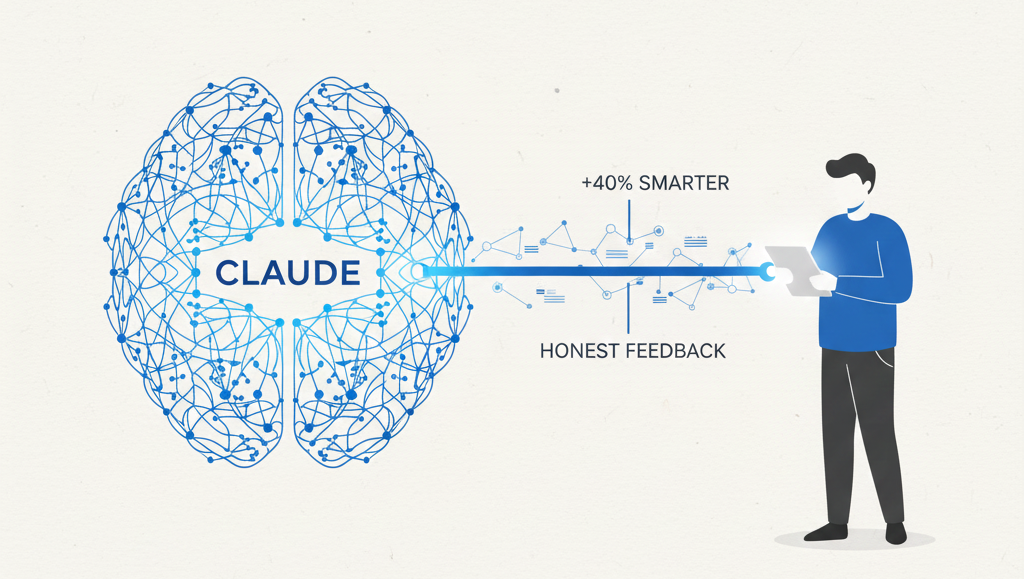
That’s where the “Claude 40% Smarter” feeling came from.
Not from adding instructions.
From removing filters.
The Shift Wasn’t Instructional It Was Contextual
I didn’t add rules like:
• “Think step by step”
• “Act as an expert”
• “Give detailed reasoning”
Those help sometimes. They weren’t the lever.
The real shift was simpler and harder:
I started writing prompts the way I think before I clean my thoughts up.
Messy openings.
Half-formed premises.
Statements followed by doubt instead of certainty.
That didn’t make the prompts clearer.
It made them truer.
And Claude responded in kind.
Addressing the Search Intent (Plainly)
If you came here wondering how to make Claude 40% smarter, here’s the honest answer:
Stop writing prompts like someone who already understands the problem.
Write from where your thinking actually is not where you wish it were.
In practice, that means:
• Don’t resolve ambiguity too early
• Include doubts, not just goals
• Remove structure unless the task demands it
• Write like you’re thinking, not requesting
No hacks.
No magic syntax.
Just fewer masks.
A Quiet Ending
I still get bad responses.
This isn’t magic.
But now, when something falls flat, I don’t blame the model first.
I ask myself:
What did I hide from the prompt because it wasn’t ready yet?
Most of the time, that’s where the gap is.
Not in the system.
In the silence I mistook for clarity.
And I’m learning slowly to leave less of that silence behind.
Releted Posts 📌
Why AI Automation Is a Blessing for Creators (And Most Don’t Realize It Yet)


1 thought on “I Accidentally Made Claude 40% Smarter by Being Uncomfortably Honest.”