
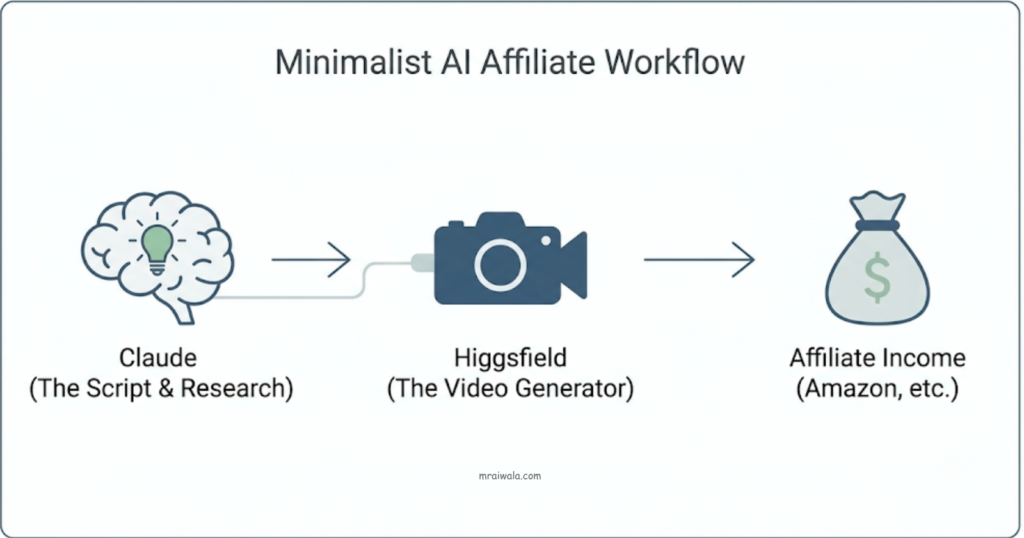
Seen reels claiming Claude and Higgsfield together will print money while you sleep? They won’t. AI affiliate marketing isn’t about letting AI make money for you. Claude and Higgsfield are content-creation tools: Claude helps you research products and plan the content, while Higgsfield turns that research into video. Neither pays you for using it.
The commission comes from a separate affiliate program, Amazon Associates, a SaaS partner program, whatever you’re actually promoting when someone buys through your link.
Quick Answer
- Pick a niche and score candidate products against a real framework, not a gut feeling.
- Get Claude to research the product and write your hook, script, and scene breakdown.
- Connect Higgsfield to Claude through Higgsfield’s official MCP connector.
- Ask Claude to turn the script into a finished UGC or faceless video through Higgsfield.
- Review it yourself, disclose properly, then publish with your tracking link.
Claude, Higgsfield, and MCP: Who Does What
| Claude | Higgsfield | MCP (the connector) | |
| Does | Niche research, product research, audience analysis, content angle, hooks, scripts, scene planning | AI image/video generation, UGC-style avatars, character consistency (Soul), voiceover and captions where supported | Connects Claude’s instructions to Higgsfield’s generation tools |
| Doesn’t do | Generate images or video | Research, write scripts, or reason about your niche | Generate anything on its own, no reasoning capability |
| In one line | The brain | The camera and editing studio | The cable between them |
Worth saying plainly, since it’s a common mix-up: connecting MCP doesn’t turn Claude into a video generator. Claude still can’t produce a video frame by itself; it writes the instructions, and Higgsfield does the generation (Source: Higgsfield MCP page, higgsfield.ai/mcp).
Does Claude or Higgsfield Have an Affiliate Program?
Claude: Anthropic runs the Claude Partner Network, launched March 12, 2026, with an initial $100 million commitment (Source: anthropic.com/news/claude-partner-network). Reading the announcement directly: eligibility is for organizations, consultancies, professional services firms, and systems-integration firms helping enterprises adopt Claude. Membership is free and gets you training, a certification path (Claude Certified Architect, Foundations), co-marketing support, and a listing in a Services Partner Directory. There’s no referral link, commission rate, or individual-creator payout anywhere in the announcement. Direct answer for a normal creator: no, you can’t sign up individually and earn a commission for mentioning Claude in a video.
Higgsfield: three genuinely distinct paths, often confused online.
- Higgsfield Earn is a paid-campaign platform, not a referral program: you generate videos against Higgsfield’s own briefs and get paid on a tiered system, capped at $1,000 on day one and $2,500 lifetime per video, with funds claimable after a Day 7 milestone and no fee to join (Source: higgsfield.ai/earn).
- Creator Partnership Program (CPP) is invite-based: credits, early model access, community support. No public application form; Earn is the self-serve on-ramp if you’re not in CPP (Source: Higgsfield Creator Hub Help Center).
- Referral/commission programs are the murky part. Reporting on a January 2026 launch describes an Ambassador Program offering up to 15% commission on referred subscriptions, tracked via Impact.com, for up to 12 months per referral. Third-party affiliate directories list different terms under different networks that don’t agree with each other. That disagreement is itself the finding: this side of the program has changed shape at least once, and no aggregator page can be trusted as current. Confirm live terms directly with Higgsfield (marketing@higgsfield.ai) before promoting Higgsfield itself for commission.
The distinction that matters for this guide: promoting Higgsfield as a product is a different activity from using Higgsfield to promote someone else’s product. This guide is entirely about the second: Claude and Higgsfield as production tools, with your income coming from whichever affiliate program covers what’s in your video.
How the Workflow Actually Works
Affiliate product → research → Claude writes the script → Higgsfield generates the video → you publish → someone clicks your link → the affiliate program pays a commission. Neither Claude nor Higgsfield touches the money. Faster production doesn’t fix a product that doesn’t sell; it just helps you find that out faster.
Connecting Higgsfield to Claude
What you need:
- A Higgsfield account; the connector authenticates through it, doesn’t create one for you.
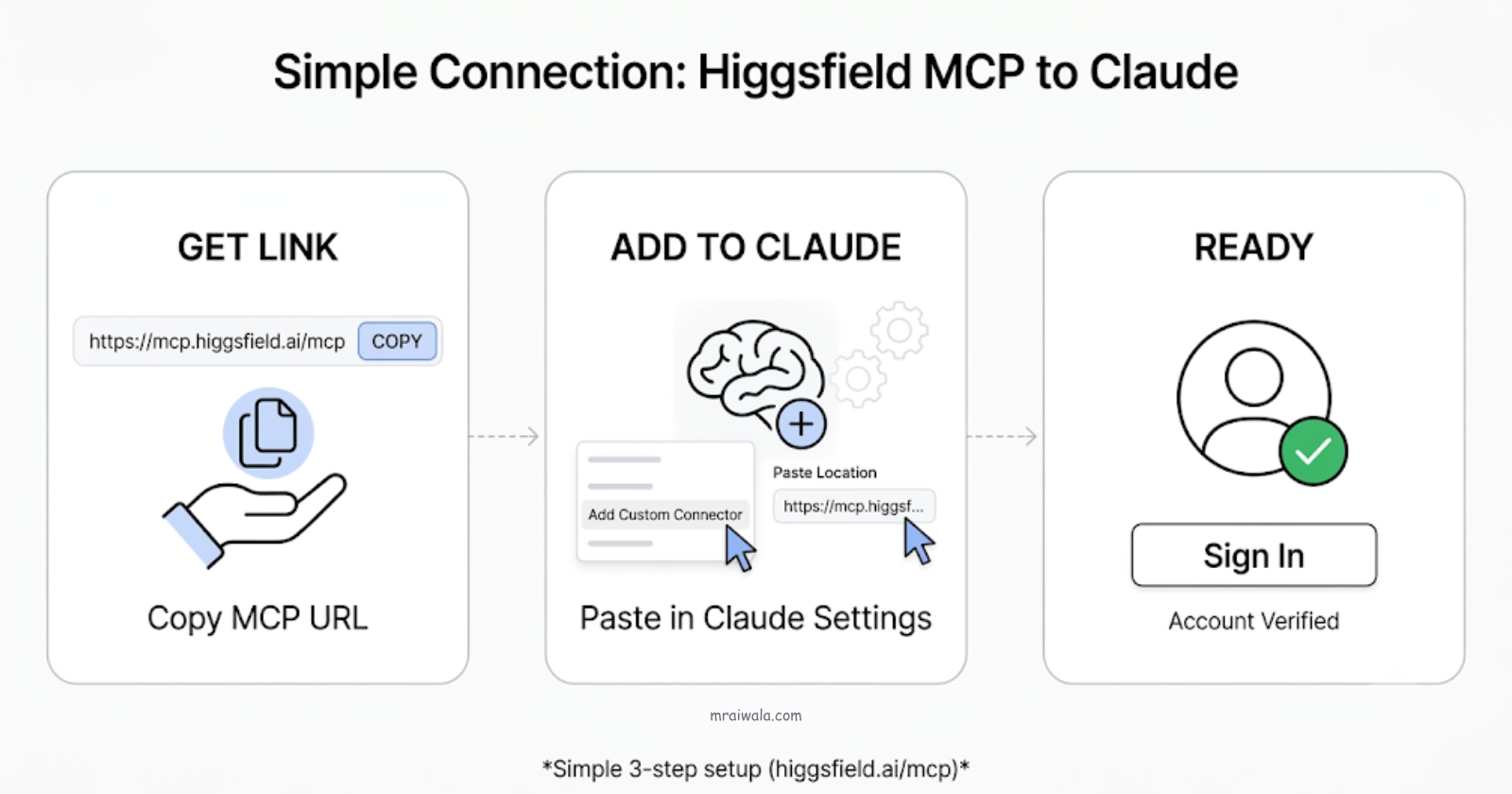
- No API key. Add the MCP server URL and authenticate through your Higgsfield account (Source: higgsfield.ai/mcp).
- Enough Higgsfield credits. MCP uses your existing plan’s credits; there’s no separate billing. Higgsfield’s free tier is credit-limited, so for real generation volume you’ll likely need a starter paid plan; check higgsfield.ai/pricing directly, since this has been restructured more than once in 2026.
- Permission to add custom connectors. On Free, Pro, and Max, you can add it yourself. On Team/Enterprise, an Owner has to enable custom connectors org-wide first (Organization Settings → Connectors). Free-plan users are capped at one custom connector total.
Setup:
- Copy the connector URL:
https://mcp.higgsfield.ai/mcp - In Claude (web or desktop), go to Customize → Connectors → Add a custom connector, name it “Higgsfield,” and paste the URL.
- Sign in with your Higgsfield account when prompted.
If you’re in Claude Code, Higgsfield recommends its dedicated CLI over the MCP connector for that environment; both work, but the CLI is the path they built for coding-agent environments specifically. Test the connection with one cheap image generation before spending real credits on anything you actually plan to use.
Claude finds the strategy. Higgsfield makes the video. Here’s how to turn both into an affiliate income workflow. Want to try Higgsfield? → Get started here
A Practical Product-Selection Framework
“Audience fit, commission, demand” as a bare checklist doesn’t help you choose between two candidates. A weighted score does not guarantee anything, just a way to stop yourself picking a product because the commission number looked big.
| Factor | Weight | What you’re judging |
| Buyer intent | 30% | Are viewers close to a purchase decision, or just being entertained? |
| Product/audience fit | 25% | Does this solve a problem your specific audience actually has? |
| Product quality/trust | 15% | Would you be fine if a friend bought this based on your video? |
| Commission economics | 15% | Rate × realistic price × expected volume, not the rate alone |
| Content potential | 10% | Is there a real demo or comparison here, or just a talking-head pitch? |
| Competition | 5% | Saturated by ten similar creators, or genuinely underserved? |
Worked comparison: a ₹15,000 kitchen appliance at 4% commission versus a ₹600 phone accessory at 8%. The appliance scores higher on buyer intent (people research big-ticket purchases before buying) and content potential (there’s a real demo to show), even though its commission percentage is lower. The accessory’s higher percentage on a much smaller base often nets a similar or smaller payout per sale, backed by less buyer intent. Run the actual numbers: rate × price before deciding.
The Workflow, Step by Step
1. Choose a niche. Ask Claude to help find where a genuine, recurring problem overlaps with products that actually solve it.
“I want to start AI-assisted affiliate marketing. I’m interested in [broad area]. Help me think through 3-4 possible sub-niches, who’d search for each, and what affiliate products commonly exist for each. Be honest about where competition is heavy.”
2. Score 2-3 candidates through the framework above. Don’t default to the flashiest commission number.
3. Research the product with Claude.
“I’m creating affiliate content for [product name]. Research and summarize: main features, the specific problems it solves, ideal customer, common objections buyers have, and how it compares to 2-3 alternatives. Keep it factual; flag anything you’re not certain about.”
4. Find the content angle: problem/solution, comparison, straight review, “best for X,” tutorial, or UGC testimonial matched to how people in your niche actually scroll.
5. Generate the hook. Get a few options in different styles (problem-first, curiosity, result-first, before/after) and say them out loud before picking. Text that reads punchy can fall flat spoken by an AI avatar.
6. Write the script.
“Write a 30-second UGC-style affiliate script for [product], using this hook: ‘[chosen hook]’. Structure: hook (3s) → problem (5s) → product intro (5s) → demo/benefit (12s) → CTA (5s). Write it the way a real person talks, not like an ad. Include a natural affiliate disclosure line in the CTA.”
7. Convert the script into Higgsfield scenes.
“Using this script [paste script], break it into 5 scenes for a UGC video and generate them through Higgsfield. Keep the same creator/avatar consistent across all scenes, 9:16 vertical, captions burned in.” Typical breakdown: problem → product → demonstration → benefit → CTA with disclosure.
8. Generate the video UGC-style with an avatar, fully faceless with product shots and voiceover, or a straight demo. Output quality depends heavily on how specific Step 7’s instructions were.
9. Review before touching variants: product accuracy, hook strength on video (not just on paper), character consistency, and whether the disclosure is actually present and legible, not buried in the last half-second.
10. Create variants; change one thing at a time (hook, CTA, or opening scene) so you can tell what actually moved the needle.
11. Publish, adapted per platform: different caption conventions, different hashtag norms. A few extra minutes re-cutting the opening frame and caption per platform genuinely affects reach.
Get the Complete Prompt Library
A Complete Worked Example
This uses a hypothetical product to show the shape of a real pass through the process; it generated no actual sales; it’s an illustration, not a case study.
Product: a foldable aluminum laptop stand, roughly ₹1,200 on Amazon India. Audience: people working from home or cafés on a laptop for long stretches, students, freelancers, remote employees. Why it fits: low price (impulse-buy range), a visible before/after (hunched posture vs. raised screen), genuine repeat search intent (“laptop stand for neck pain,” “wfh setup”). Research (via Claude): foldable/portable, aluminum, adjustable height, ventilation gaps for cooling; common objection is stability on soft surfaces like beds; main competitor category is cheaper plastic stands that wobble. Angle: problem/solution: neck and back strain from looking down at a laptop all day. Hook:“Nobody tells you your laptop is the reason your neck hurts by 6 pm.”
Script (15s):
- Hook: “Nobody tells you your laptop is the reason your neck hurts by 6 pm.”
- Problem: “Screen too low, neck bent all day, and you just accept it.”
- Product: “This foldable stand raises it to eye level in about five seconds.”
- Benefit: “Neutral neck position, better airflow under the laptop too.”
- CTA: “Link in bio. As an Amazon Associate, I earn from qualifying purchases.”
Scenes for Higgsfield: 1) creator mid-workday, rubbing neck, laptop flat on desk 2) close-up unfolding the stand 3) laptop placed on stand at eye level 4) creator visibly relaxed, typing comfortably 5) creator to camera, CTA and disclosure.
Generation instruction: “Generate this 5-scene, 15-second UGC video in 9:16, consistent creator across all scenes, natural indoor lighting, captions burned in, casual delivery.”
Human verification before publishing: Does the stand actually look stable in the clip (a real buyer objection)? Is the disclosure both spoken and shown as text? Does the script overstate anything (e.g., claiming it “cures” neck pain, which it doesn’t)?
Disclosure placement: spoken in the CTA, plus a permanent text overlay in the corner, plus “#ad #affiliate” in the caption, not buried after ten hashtags.
CTA/link placement: “link in bio” spoken in-video; the actual tracking link goes in the bio or a Linktree, since Reels/Shorts captions generally don’t support clickable links the way bios do.
What to test in variants: a result-first hook (“My neck pain basically disappeared after this”) against the curiosity hook above; on-screen price callout vs. none; a 30-second cut that directly addresses the wobble-resistance objection.
AI Affiliate Marketing Without Showing Your Face
This is a real, common approach: AI avatars, voiceover-only, screen recordings, text-driven videos. It doesn’t guarantee views or sales just because it’s AI-generated: a faceless video with a weak hook performs exactly as poorly as a face-on-camera video with a weak hook. Virtual presenters also carry an extra disclosure requirement, covered below.
One Product, Many Pieces of Content
Once the research in Steps 1-3 is done, the same product can become a UGC testimonial, a demo, a comparison, an FAQ video, and a blog post without repeating the research. Research once, produce many; the win isn’t one video going viral, it’s consistent variety to test against your specific audience.
Do You Need a Website? for AI Affiliate Marketing
No, not to start. Social-first works with an Instagram bio link, a YouTube Shorts description, and a Linktree page. This is the lowest-friction way to begin, and it’s where this workflow’s output naturally lives (it’s also why “link in bio” shows up as the standard CTA in Step 6; Reels captions generally don’t carry clickable links the way bios do).
A website earns its place once you outgrow that: it gives you search traffic that doesn’t depend on an algorithm’s mood, room for comparisons a 30-second video can’t hold, and a page you fully control instead of one hosted on someone else’s platform.
Social media gives you traffic. Your website gives you ownership. Build your affiliate business with Hostinger. Get 20% off.
Revenue vs. Profit
The starting formula: Traffic × click-through rate × conversion rate × commission rate = gross affiliate revenue. But that’s revenue, not profit:
Profit = affiliate revenue − AI generation costs (Higgsfield credits) − other software/content costs − your time, if you’re pricing it
Illustrative example, not an earnings projection. 20,000 views, 2% CTR → 400 clicks, 3% conversion → 12 sales, ₹1,200 average order at 4% commission → ₹48/sale → ₹576 gross revenue. Higgsfield credits for the video plus 2 variants: roughly ₹250-400. Illustrative profit: roughly ₹175-325, before your own time. Views don’t equal sales, clicks don’t equal commissions, and commissions don’t equal profit once generation costs are subtracted. A video that looks like a hit on views can still be a net loss once credits spent chasing variants are counted.
India-Specific: Amazon Associates Commission
Amazon India publishes rates in its Associates Program Advertising Fee Schedule (Source: affiliate-program.amazon.in/help/operating/schedule), organized by category, each with its own rate that Amazon can change anytime. A few things worth knowing rather than a blanket percentage:
- Several categories earn zero commission regardless of price: flight bookings, gift cards, bill payments/recharges, gaming consoles/hardware, Prime membership, and Amazon Pay balance top-ups.
- A defined list of budget phone models carries a reduced 1% rate.
- Beyond these specifics, don’t build a strategy around a percentage number from any blog post, including this one; check the live schedule before committing to a category. This is also why the framework above weights commission economics at only 15%, and treats it as rate × price × volume, not rate alone.
Compliance and Disclosure
These are genuinely separate layers; collapsing them into one rule is where a lot of well-meaning content goes wrong.
Affiliate/commercial disclosure. ASCI’s Guidelines for Influencer Advertising require disclosure whenever there’s a material connection between you and what you’re promoting; this includes free products, discounts, or perks, not just direct payment, and applies even when your review is genuinely unbiased. No disclosure is needed for a personal purchase with no connection to a brand, but the moment a commission is involved, that carve-out doesn’t apply. Disclosure must be upfront and prominent; approved labels include “Affiliate,” “Advertisement,” “Ad,” “Sponsored,” “Collaboration,” “Partnership,” Instagram’s “Paid Partnership,” or YouTube’s “Includes Paid Promotion.” Vague terms like “collab” alone don’t meet the bar (Source: ASCI, Social Media Disclosure Guidelines, ascionline.in/social/guidelines).
AI/virtual presenter disclosure is separate, layered on top. ASCI defines a virtual influencer as a computer-generated avatar with human-like traits, and requires disclosure that the presenter isn’t a real human, also upfront and prominent. A Higgsfield UGC avatar fits this definition directly, so your video needs both disclosures, not one doing double duty.
Truthful claims. ASCI places a due-diligence obligation on you specifically; you’re expected to reasonably verify that claims in the video can be substantiated. If Claude’s draft includes a claim you haven’t independently checked an effect, a competitor comparison, a “clinically proven” statement cut it before publishing. An AI writing tool can only reflect what’s commonly said about a product online; that’s not verification. For finance and health-related products, ASCI’s Addendum 2 additionally requires you to hold and disclose relevant qualifications (SEBI registration, IRDAI license, medical certification) before giving that kind of advice.
Platform rules are a separate layer again. Meeting ASCI’s standard doesn’t automatically satisfy a platform’s own paid-partnership tools or vice versa, where a platform offers a built-in label (Instagram’s Paid Partnership, YouTube’s Includes Paid Promotion), use it alongside a visible on-screen label, since the two can diverge.
Common Mistakes
- Choosing the product before understanding the audience. Produces content that’s technically about a real product but lands with no one specific.
- Generic AI UGC. A script and avatar that could sell any product blends into the feed. Name the exact objection your audience has.
- Publishing unverified AI-generated claims. Read every factual claim before it goes to Higgsfield, not after the video’s made.
- Reposting without adaptation. Different platforms have different caption norms and link behavior; a few minutes of re-cutting is worth it.
- Changing too many variables at once. Swap hook, CTA, and opening scene together and you learn nothing about what mattered.
- Optimizing for views instead of buyer intent. Entertaining videos can rack up views from people who were never going to buy.
- Skipping disclosure. ASCI treats non-disclosure as enforceable, and the Consumer Protection Act adds legal weight beyond ASCI’s own process.
- Ignoring generation costs. Five variants generating one small commission is a net loss; track credits spent against what you actually earn.
FAQ: AI Affiliate Marketing with Claude and Higgsfield
Does Claude have an affiliate program?
Not an individual, link-based one. The Claude Partner Network is real, but built for organizations doing enterprise implementation, not referral commissions.
Does Higgsfield have an affiliate program?
Distinct paths: Earn (paid campaigns), CPP (invite-based), and a referral/ambassador history with commission on subscriptions. Terms for the referral side are inconsistent across sources; verify directly with Higgsfield.
What is Higgsfield Earn?
A paid-campaign platform generate videos against Higgsfield’s briefs, paid on a tiered system, capped at $1,000 on day one and $2,500 lifetime per video.
What is Higgsfield MCP?
Higgsfield’s hosted MCP server lets Claude send generation instructions and get finished images/video back in the same conversation, no API key required.
How do I connect Higgsfield to Claude?
Add https://mcp.higgsfield.ai/mcp as a custom connector via Customize → Connectors, and sign in with your Higgsfield account. Team/Enterprise plans need admin approval first.
Ready to try Higgsfield? Start here. Try Higgsfield
Can I do this without showing my face?
Yes, but an AI avatar needs a separate disclosure that the presenter isn’t real, on top of your affiliate disclosure.
How much does Higgsfield MCP cost?
The connector itself is free; it runs on your existing Higgsfield plan credits. Pricing has changed more than once in 2026; check higgsfield.ai/pricing directly.
What to Do Next
Connect Higgsfield to Claude, run one product through the scoring framework, and take it through Steps 1-9 exactly once. Review that single video honestly: disclosure, claims, character consistency before touching variants or a second product. The workflow scales once you know where your bottleneck actually is: script quality, video quality, or product-market fit. You won’t know which until you’ve made one and looked at it critically.
Ready to create your first AI video? → Get started with Higgsfield here

1 thought on “AI Affiliate Marketing with Claude & Higgsfield: From Research to Sales”