

Most “AI side hustle” lists give you the same five ideas and stop there. There’s no fee breakdown, no tool stack, and no honest read on how long it takes to see any money. That gap is why most people quit in month two, confused about why the idea “isn’t working.”
Here are five models where AI tools change the math in 2026, not because AI does the work for you, but because it removes the slowest part of each one:
- Newsletter writing: done-for-you email content for businesses too busy to write their own
- Shopify landing page design: fixing the page an ad sends traffic to, for brands already spending on ads
- Niche AI content and audience monetization: building a consistent presence and getting paid through creator programs, sponsorships, and affiliate links
- Local SEO services: getting neighbourhood businesses found on Google Maps
- Selling digital products on Etsy: templates, planners, and printables, AI-assisted
None of these pay on day one. Every one of them is a small business, not a task. If you want paid gig work you can start this week, our guide to freelance AI jobs covers that ground instead. This article is for the version of you who wants to own something.
A quick honest answer before the breakdowns: there’s no reliable public data on which of these five is “most profitable.” Anyone who gives you a specific number is guessing or selling you something. What actually decides your outcome is which one matches your existing skill, how much unpaid ramp-up time you can absorb, and whether you can find the first three clients or customers. The sections below are built around that.
One idea repeats across newsletter writing, Shopify pages, and local SEO: proof before pitching. Give a stranger something small and bounded to judge before asking for money. That’s different from free labor, where you do the real paid project for nothing. Etsy and AI content skip this step; demand validation and consistent posting do that job there.
1. Newsletter writing for businesses
Most small businesses and solo creators know they should email their list regularly. Almost none of them do it consistently, because writing a good email every week is a real skill and a real time cost. That gap is the service.
You’re not selling “AI-written emails.” Clients can tell, and it reads flat. You’re selling research, structure, and a consistent publishing habit, with AI handling the first-draft speed so you can take on more clients than a fully manual writer could.
Best for: confident writers who can hold a client relationship past project one.
Avoid if: you can’t commit to a fixed weekly or biweekly schedule.
What you’re selling: a fixed package, say 2-4 newsletters a month, with research, an AI-assisted first draft, your edit, and a short performance note on opens and clicks. Clients pay for the habit and the reporting, not just the words.
Tech stack & workflow:
- Use Claude to turn a client’s raw updates, product notes, or voice notes into a structured first draft. You still edit for their actual voice.
- Publish through Beehiiv, which has a free plan for up to 2,500 subscribers with unlimited sends. It’s good enough to run your own portfolio newsletter or a small client’s list before you need a paid plan.
- Track what actually gets opened and clicked. That data is what you use to justify a rate increase later, not guesswork.
How you get your first customer: target businesses or creators who already have an email list but rarely use it. That’s a visible, specific gap, and one sample newsletter in their niche makes the pitch concrete instead of generic.
Reality check
| Required skill | Problem it solves | Startup cost |
| Clear writing, ability to sound like someone else (the client), basic research | Businesses want retention and repeat sales but don’t have time to write | Free to start; Beehiiv’s free plan covers early testing |
The honest limitation: this is a service business, so your income is capped by your own hours until you either raise rates or bring on help. It’s also slow to start. Nobody pays a stranger to manage their newsletter, so you need a visible sample first.
Your first 3 actions:
- Pick one business niche.
- Write three sample newsletters for it.
- Find ten relevant businesses and pitch your samples.
First monetization milestone: your first paid newsletter client on a recurring retainer, not a subscriber count.
2. Shopify landing page design
Every day, thousands of Shopify brands run paid ads to a product page that’s badly built: slow, cluttered, or not actually written to convert a stranger into a buyer. The brand is already spending money to get the click, so a better landing page is the difference between that spend working or not. That’s an easier pitch than cold-selling “marketing services” from scratch, because you can show the brand its own problem before you say a word.
Best for: people who don’t mind pitching strangers and can spot why a page isn’t converting.
Avoid if: cold outreach drains you. Good design never fixes a pitch you never send.
What you’re selling: a rebuilt landing page (layout, copy, structure) delivered as a working page-builder template, not a mockup image.
Tech stack & workflow:
- Use the Meta Ad Library, a free, public, no-login tool from Meta, to find e-commerce brands currently running ads. Click through to see their actual landing page.
- Join the free Shopify Partner Program to get unlimited free development stores. You can rebuild a mock version of a brand’s page as a portfolio piece without paying Shopify a rupee. The client’s business pays for the live Shopify plan, not you.
- Use Claude for above-the-fold copy and structure, and a Shopify page builder app for the layout itself.
- Pitch with a before/after: their current page next to your rebuilt version.
How you get your first customer: the Meta Ad Library shows you who’s already spending on ads. Pick a brand whose landing page clearly isn’t converting that spend. That’s a specific, provable problem, not a cold pitch.
Reality check
| Required skill | Problem it solves | Startup cost |
| Landing page structure, basic conversion copywriting, comfort with cold outreach | Ad spend is wasted on a page that doesn’t convert | Free; Shopify dev stores are free for partners |
The honest limitation: this is outbound sales work dressed up as design work. The design matters less than your willingness actually to send the pitch.
Your first 3 actions:
- Find ten Shopify brands currently running ads.
- Choose one product page with a clear conversion problem.
- Build a before/after redesign as your portfolio sample.
First monetization milestone: your first paid landing-page project, not the spec sample itself.
3. Niche AI content and audience monetization
This is building a consistent content presence in a narrow niche, using AI video and image tools to produce at a pace a solo person manually couldn’t, and monetizing it through a mix of creator-program payouts, affiliate links, and eventual sponsorships.
Best for: people willing to post consistently for months before it pays anything meaningful.
Avoid if: you need income within weeks. This has the longest, least predictable runway of the five.
What you’re monetizing: attention in one niche, through campaign payouts, niche-relevant affiliate links, and eventual sponsorships once the audience is real.
Tech stack & workflow:
- Tools like Higgsfield let you build a consistent AI character. Its Soul feature keeps a face and style stable across videos, so your content looks like one persona, not a random AI demo reel each time.
- Higgsfield Earn is a direct, self-service way to get paid: you post AI-generated video against the platform’s live campaign briefs and earn based on performance, with a published cap of $1,000 on day one and $2,500 lifetime per video, and funds become claimable after a day-7 milestone. There’s no fee to join.
- The Creator Partnership Program (CPP) is a separate, invite-only track for creators with an established audience. There’s no public application, so it isn’t a starting point.
- Use Claude for scripting and hooks; the actual growth still comes from posting consistently in one niche, not from the tool.
Use ElevenLabs for AI voiceovers when your content needs narration, AI character voices, or a consistent synthetic voice.
How you get your first customer: there isn’t one, in the usual sense. The audience comes first, and monetization follows through whatever campaign, affiliate, or sponsorship opportunities open up once it exists.
Reality check
| Required skill | Problem it solves | Startup cost |
| Consistency, comfort building a persona (real or AI), basic short-form editing sense | Brands and platforms pay for attention in a niche; solo creators struggle to post enough to build one. | A paid Higgsfield plan (check higgsfield.ai/pricing for current tiers pricing shifts often) |
The honest limitation: platform-paid campaigns are capped and depend on which briefs are live when you check. They’re not a guaranteed monthly income. And if you’re using an AI persona or posting sponsored content to an Indian audience, ASCI’s disclosure rules on material connections still apply to you. “AI-generated” and “paid promotion” both need to be disclosed, not implied.
Your first 3 actions:
- Pick one narrow niche.
- Create a repeatable content format.
- Publish consistently for 30 days and track what gets traction.
First monetization milestone: your first legitimate campaign payout, affiliate commission, or sponsorship enquiry, whichever lands first.
4. Local SEO services
Local businesses (gyms, dentists, salons, repair shops) live or die by whether they show up in Google’s local map pack when someone nearby searches. Most of them have an unclaimed, half-filled, or poorly-optimized Google Business Profile, because nobody at a small business has time to manage it. That’s the entire service.
Best for: people comfortable with operational detail and talking to local business owners directly.
Avoid if: you want one-off projects. This only works as an ongoing retainer.
What you’re selling: GBP setup and optimization, review responses, monthly updates, and local landing-page tweaks, bundled as one retainer, not a single fix.
Tech stack & workflow:
- Google Business Profile (GBP) is free and is the single biggest factor in local ranking. Completing categories, hours, services, and photos correctly, and posting updates, all measurably help.
- Use Claude to draft the business description, service listings, and GBP posts in the owner’s voice, and to write location-specific landing page copy for their website.
- Build a review-response habit for the client. Replying to every review, not just the bad ones, is a ranking and trust signal.
- Offer a free GBP audit as your pitch: show the business owner exactly what’s missing before asking for money.
How you get your first customer: local businesses with a half-finished or neglected Google Business Profile are easy to spot. A short audit showing three to five specific issues is a more concrete pitch than any cold outreach line.
Reality check
| Required skill | Problem it solves | Startup cost |
| Attention to operational detail, comfort talking to local business owners, basic on-page SEO | Local businesses lose customers to competitors who simply have a better-filled-out Google listing. | Free; GBP is free, and a paid rank-tracking tool can wait until you have paying clients. |
The honest limitation: this is retainer-based service work. That means recurring income but also recurring accountability. A client expects ongoing results, not a one-time fix, and results can take weeks to show in rankings.
Your first 3 actions:
- Pick one local business category.
- Audit five businesses’ Google Business Profiles.
- Turn one audit into a pitch for monthly management.
First monetization milestone: your first paying recurring client, not the free audit.
5. Selling digital products on Etsy
Templates, planners, printables, and similar digital downloads sell well on Etsy because there’s no shipping, no inventory, and low per-listing cost. AI design tools make it realistic to build a small catalog without being a trained designer. But “AI-generated” doesn’t mean “no work.” Validated demand and good execution still decide whether anything sells.
Best for: people who’d rather design and validate alone than pitch or manage clients.
Avoid if: you want to skip keyword validation and just design what you personally like.
What you’re selling: one specific product type (templates, planners, or printables), validated against real search demand first, not a general AI-art catalog.
Tech stack & workflow:
- Validate demand before designing anything. eRank has a solid free plan for keyword and demand research, and Alura also offers a free tier. Check whether people are actually searching for a product idea before you spend hours on it.
- Design with Canva or an AI image tool, and use Claude to write SEO-friendly titles, tags, and listing descriptions.
- Etsy’s fee structure, as of 2026: a $0.20 listing fee per item, a 6.5% transaction fee on the total sale price including shipping, and a payment processing fee of 3% + $0.25 for US-based payouts. There’s no mandatory monthly subscription; Etsy Plus at $10/month is optional. Together, fees typically run 10-13% of a sale before any paid advertising.
- Disclosure isn’t optional. Etsy has required sellers to disclose AI-generated design, image, or description content since its 2024 Creativity Standards, and listings using AI content should be marked “Designed by” rather than “Made by,” with a clear statement in the listing description. Undisclosed AI use risks listing removal.
How you get your first customer: skip individual outreach entirely. Validate demand through Etsy’s own search and keyword data first, and build only around what people are already searching for.
Reality check
| Required skill | Problem it solves | Startup cost |
| Design sense (or willingness to iterate), keyword research discipline, listing SEO | Buyers want ready-made templates and printables without hiring a designer | Near-free to list; main cost is your time, and Etsy’s cut is roughly 10-13% per sale |
The honest limitation: Etsy’s digital product space is crowded, and a listing with no search demand behind it won’t sell no matter how well it’s designed. Validation isn’t optional here. It’s the step most people skip.
Your first 3 actions:
- Research three product ideas.
- Validate their search demand.
- Create and list five to ten products around the strongest idea.
First monetization milestone: your first organic sale, or a first small run of validated sales, not one lucky listing.
A quick side-by-side comparison
| Model | Client work | Content/production work | Speed to first test | Difficulty |
| Newsletter writing | High | Medium | Fast | Moderate |
| Shopify landing pages | High | Medium | Moderate | Moderate-High |
| Niche AI content | Low | High | Fast | High |
| Local SEO | High | Low | Fast | Moderate |
| Etsy digital products | Low | High | Slow | Moderate |
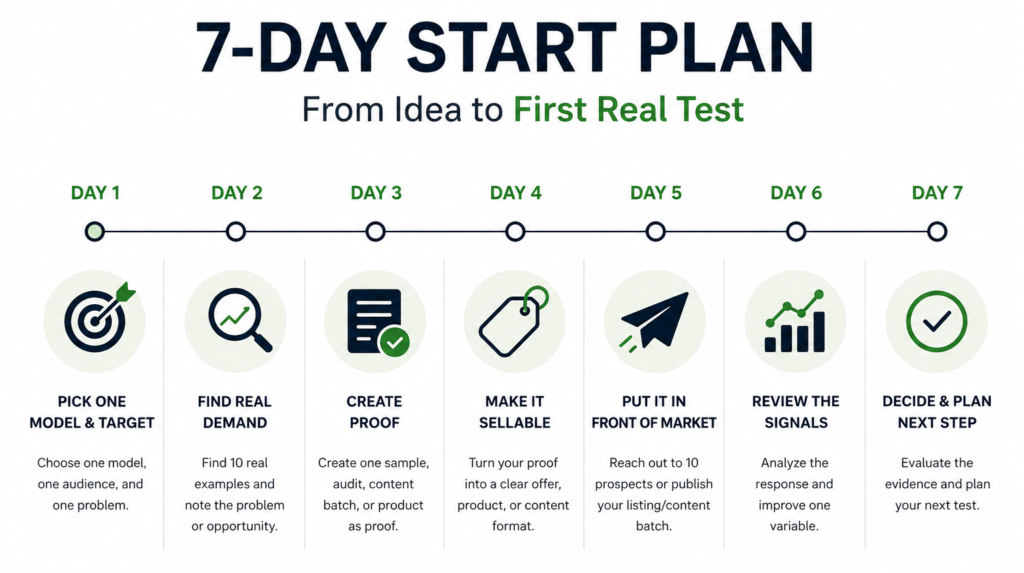
Your 7-Day Start Plan: From Idea to First Real Test
Don’t spend your first week watching tutorials, buying AI tools, or building a perfect website. Pick one model, create something useful, put it in front of real demand, and use the response to decide what to do next.
Skip the tutorials. When you’re ready to launch, build a simple, affordable website with Hostinger to build trust and turn visitors into clients.
A real test means putting your work in front of potential buyers, users, or actual search demand. Asking friends whether they like the idea doesn’t count.
Set aside roughly 60-90 focused minutes a day. Each day should produce one tangible result.
Day 1: Pick one model and one target
Choose one model, one specific audience, and one problem you can solve.
- Newsletter writing → a business niche with an existing email list.
- Shopify landing pages → an e-commerce niche already running ads.
- Niche AI content → a narrow audience you can consistently create for.
- Local SEO → one local business category you can research and contact.
- Etsy → one product category with visible search demand.
Then write: “I help [specific customer] get [specific outcome] through [specific service/product].”
Output: one target and one specific problem.
Day 2: Find real demand
Find 10 real examples already showing demand.
- Newsletter: businesses or creators with an existing but inconsistent email list.
- Shopify: find brands running ads through the Meta Ad Library and inspect their landing pages.
- AI content: find a niche where people already consume and discuss content.
- Local SEO: find businesses with incomplete or neglected Google Business Profiles.
- Etsy: use Etsy search and keyword tools to find products people are already searching for.
Note one specific problem or opportunity for each.
Output: 10 prospects, or 3 validated product/content opportunities.
Day 3: Create proof, not a portfolio
Create one small piece of work that demonstrates what you can do.
- One sample newsletter.
- One Shopify above-the-fold redesign.
- Three pieces of content in one repeatable format.
- One Google Business Profile audit with 3-5 issues.
- One Etsy product based on the strongest validated idea.
Output: one sample, audit, content batch, or product you can show.
Day 4: Turn the proof into something sellable
A skill isn’t an offer. Make the deliverable clear.
“I’ll create four research-backed newsletters per month, including drafting, editing, publishing support, and a simple performance report.”
Keep the first offer small, specific, and easy to understand. Start with a clearly scoped paid test rather than trying to set your permanent price.
For Etsy, define the product. For AI content, define the repeatable content format and monetization path.
Output: one starter offer, product, or content format.
Day 5: Put it in front of the market
For service models, contact 10 relevant prospects, not 100 random businesses.
Your message should show:
- What you noticed.
- What you’d improve.
- A small piece of proof.
- A simple next step.
Use the channel where your target already exists: LinkedIn or email for businesses and creators, Google Maps for local businesses, and the Meta Ad Library for Shopify prospecting.
For Etsy, publish the first product. For audience-building, publish the first content batch.
Output: 10 personalized pitches, or your first listings/content batch.
Day 6: Review the signals
Look at what the market is telling you.
- Services: replies, conversations, objections, price questions, or confusion about the offer.
- Etsy/content: impressions, clicks, saves, search visibility, or engagement.
Change one variable only: target, offer, proof, message, product, or content format.
For services, prepare a follow-up for prospects who haven’t responded. For Etsy or content, focus on the strongest early signal.
Output: one improved version based on real feedback.
Day 7: Decide what the evidence says
Seven days won’t prove a business model. It can tell you whether your first test has enough signal to continue.
Ask:
- Did I identify a real problem?
- Could I produce the work effectively?
- Did people respond, click, search, or engage?
- Did a repeated objection or pattern appear?
- Do I know what to test next?
Client services: 10 targeted pitches should reveal something about your targeting, offer, and message. One meaningful conversation is stronger than ten ignored generic pitches.
Etsy: look for search visibility, clicks, favorites, or sales across several validated listings.
AI content: continue the format long enough to judge repeatable engagement, not one viral post.
What to do after the seven days
If the signals are promising, run another 30-day test with one clear improvement.
If there’s little or no signal, change one major variable (the niche, offer, proof, product, or format) and test again.
Don’t buy more AI tools to fix weak demand or an unclear offer.
Your goal after seven days isn’t a business. It’s evidence.
A successful first week leaves you knowing who you’re targeting, what you’re offering, how the market responded, and what you’re testing next.
Which one should you actually start?
Run through these questions in order, and stop at the first one that fits.
Do you want a small number of recurring clients, not one-off projects? → Yes: newsletter writing or local SEO fit best. → No: keep going.
Are you comfortable reaching out to strangers, with cold pitches, spec samples, and follow-ups? → Yes: Shopify landing pages or local SEO. Shopify especially rewards people who can pitch, not just build. → No: keep going.
Would you rather build something once and sell it to many people than manage clients directly? → Yes: Etsy digital products are the least client-facing option here, though the ramp-up is slower. → No: keep going.
Are you willing to post consistently for months before it pays anything meaningful? → Yes: niche AI content. Go in knowing the income is uneven, and the runway is the longest of the five. → No: a client-service model suits you better than the audience-building route.
Skip all five for now if you can’t commit at least a few real hours a week for two to three months before expecting any return. That ramp-up time isn’t optional in any of these, whatever else you read.
This isn’t a scored quiz. It’s a quick way to rule out what clearly doesn’t fit before you commit weeks to testing one.
FAQ for AI Side Hustles for Beginners
Do I need to know coding or design to do any of these?
No, but you need a baseline skill in each model’s core task: writing, layout, SEO, product presentation, or operations. AI can speed up execution, but it doesn’t replace the judgment needed to produce work that gets results. For Shopify landing pages, basic familiarity with Shopify’s editor and conversion-focused page structure is enough; you don’t need to be a developer.
Are these realistic alongside a full-time job?
Yes. Newsletter writing, local SEO, Etsy, and audience-building can be started in evenings and weekends. Shopify landing-page work is more outreach-heavy and may be harder if you can’t respond to prospects during business hours.
How much money do I need to start?
You can test all five with little or no upfront spending. Beehiiv, Shopify development stores, Google Business Profile, and eRank offer free ways to get started. Some costs can come later, such as Etsy fees, a domain, or paid software.
How many hours a week do I need?
Around 5–10 focused hours a week is enough to test a model. Use that time consistently for the activities that create results: building samples, outreach, publishing, or improving your offer.
Which one should I choose?
Choose the model that matches your existing skills and the type of work you can do consistently. For faster feedback, consider a client-service model such as newsletter writing, local SEO, or Shopify landing pages. If you’d rather build something you own, Etsy or audience-building may be a better fit.
If you’re still deciding between a client-service model and something more product-based, our breakdown of online earning platforms for beginners covers the wider landscape. Otherwise, pick one model, give it a genuine 30-day trial, and use the results to decide whether it’s worth investing more time or money.
Read This Next 📌
AI Affiliate Marketing with Claude & Higgsfield: From Research to Sales
I Tried 7 AI Freelancing Services. 5 Were Useless. 2 Actually Paid Me
From $0 to $1K/Month With AI Automation in 90 Days (Exact Workflow)
5 AI Freelance Jobs From Home That Actually Pay $400–$600/Month
