

AI tools can write a product description in seconds. They can’t write a hundred descriptions in one brand voice, use only the facts the seller approved, and flag missing details on their own. That gap is where a prompt engineering side hustle makes sense.
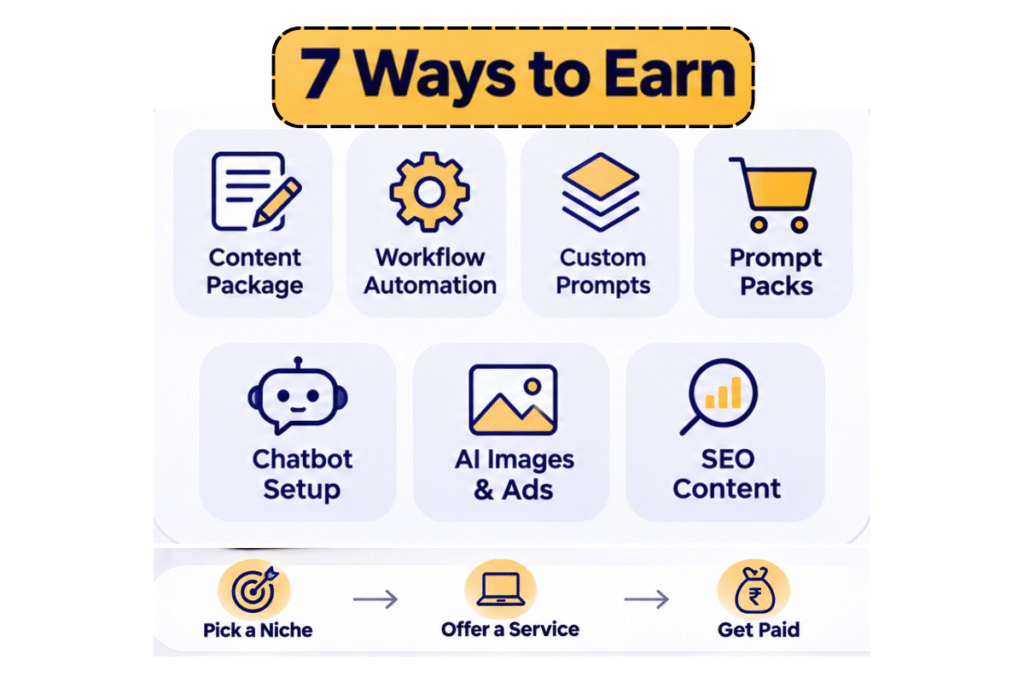
A business will rarely pay for a clever prompt. It pays for a result it can use: content that is ready to publish, a workflow that saves an hour a day, or a chatbot that answers routine questions correctly. This guide covers seven ways to earn from that skill: content packages, workflow automation, custom prompt systems, niche prompt packs, chatbot setup, AI image and ad creatives, and SEO content. It also explains which platforms work from India, what they cost, how to price your work, and how to find your first customer.
The short answer: if you already know a niche such as Etsy selling, real estate, or salons, start with a niche prompt pack or a content package for that audience. If you do not know a niche yet, start with a content service. It needs the least setup and shows you what clients actually ask for.
What is an AI prompt engineering side hustle?
It means using prompts and AI workflows to solve a specific problem for a business or an individual, and getting paid for the result. The product could be a downloadable template, a monthly content package, a working automation, or a configured chatbot.
Most of these do not need coding. They do need testing. You have to run your prompts on many different inputs, catch the AI’s mistakes, and tell clients plainly what still needs human review. AI output can contain wrong facts, so check everything before publishing it or using it in a business.
Is AI prompt engineering still worth doing in 2027?
“Prompt engineer” as a job title has lost much of its shine. Today’s AI models follow plain instructions far better than they did a few years ago, and a buyer can often get a decent draft by simply asking ChatGPT or Claude. That is why bare prompts sell for very little.
What still earns money is the work around the prompt: knowing what to ask for, testing it on messy real inputs, keeping facts accurate, and delivering something a business can use without rewriting. Every method in this guide is built on that. The market also changes fast, so treat everything here, including fees and prices, as a snapshot.
Do you need coding, a course, or money to start?
- Coding: Not for most of the seven ways. Workflow automation and chatbots need comfort with no-code tools like Make, Zapier, or a chatbot builder, but not programming.
- Course: Not at the start. A free AI assistant and a few weeks of practice on real tasks will teach you more than a paid bundle. Spend money only after you know which offer you are building.
- Money: You can begin with the free tiers of an AI assistant and Canva. Costs come later: paid AI plans for heavy testing, automation tools, a website, or marketplace setup fees.
- Time: Plan for several weeks of testing and sample-building before your first paid job. Nobody can honestly promise you a timeline.
Which of the seven should you start with?
| If this sounds like you | Start with |
| You know one niche well and want low setup effort | Way 4 (niche prompt packs) or Way 3 (custom prompt systems) |
| You write and edit well. | Way 1 (content service) or Way 7 (SEO content) |
| You like logic, spreadsheets, and connecting tools | Way 2 (workflow automation) |
| You have a visual eye. | Way 6 (image and ad creatives) |
| You are comfortable talking to business owners and handling support | Way 5 (chatbot setup) |
Whichever you pick, begin with one audience and one task. The roadmap near the end shows how.
1. AI content creation service
Many small businesses need regular content and have no time to plan and write it. You use AI for drafts and ideas, and your prompts keep the output close to the business’s voice, audience, and offers.
What you can sell: social media posts and captions, product descriptions, email newsletters, content calendars, and short video scripts.
Example: a home baker in a smaller Indian city takes cake orders on Instagram but posts only when she finds time. You offer a monthly package with 12 feed captions, 4 festival posts (Diwali, Raksha Bandhan, Christmas), and 10 story ideas, all built from her menu, price list, delivery area, and order lead times. The AI drafts from those inputs only, so it has nothing to invent flavours or prices from.
Workflow: learn the business, audience, and services. Write a short brand voice guide. Build a prompt for each content format. Generate drafts, edit them for accuracy and originality, and deliver everything as a calendar the owner can approve.
Check before delivery: AI drafts often add details nobody supplied. A caption might call a cake eggless, sugar-free, or made with organic flour when the baker never said so, and a wrong ingredient claim can mislead customers with allergies or dietary rules. Check every ingredient, price, delivery, and offer claim against the baker’s own list, and make sure posts do not repeat the same idea.
Finding clients: start with businesses you can reach directly, such as gyms, salons, coaching classes, or small online shops, then add marketplaces like Fiverr and Upwork. Describe the outcome, not the tool: “I help salons plan a month of Instagram posts in their own voice.” Local clients can usually pay by UPI or bank transfer, so a sample package priced in rupees makes the first conversation easy.
Skills and tools: writing and editing, a brand voice template, and one AI assistant.
Main risk: unchecked claims. Keep a facts sheet the client has signed off on, and publish only from it.
2. AI workflow automation
Here you connect AI tools with other apps so that a repetitive task runs with less manual effort. It is more technical than selling prompts, and it solves problems businesses will pay to fix.
What you can sell: lead classification, draft replies to customer inquiries, product description workflows, data categorisation, and idea-to-draft content pipelines.
Example: a coaching institute gets admission inquiries through a website form. A workflow can read each submission, classify it by course, class level, and urgency, draft a reply that links the right fee brochure, log the lead in a Google Sheet, and alert a counsellor to review the draft before anything is sent. What the institute saves is the counsellor’s time spent sorting inquiries and typing the same first reply.
Your prompts decide how the AI classifies information, what format it returns, and what it does when details are missing. Tools such as Make, Zapier, and AI APIs handle the connections.
Test before you sell. A workflow that works on one example is not ready for a client. Run it on a complete input, missing information, an unexpected format, a wrong AI output (can a person review and correct it?), a failed app connection (is the failure shown or recorded?), and a duplicate submission (does it avoid doing the work twice?).
Customer data will pass through an AI tool, so read that tool’s data terms and agree with the client what may be sent. Start with one repetitive task and build one reliable example before you offer it to anyone. You will need a working knowledge of triggers, actions, webhooks, data formatting, and error handling.
3. Custom AI prompt systems for businesses
Some businesses do not need full automation. They need ChatGPT or Claude to give better and more consistent results. A prompt system is a set of tested instructions built around one business task.
Example: a handloom saree seller writes listings with ChatGPT, but the descriptions sound generic and sometimes claim pure silk or zari work that the saree does not have. You build a system with a product sheet (fabric, weave, length, blouse piece, colour, care), a short brand voice note, a rule that the description may state only what the sheet says, a fixed output format, and a final checklist.
What the client should receive:
- a reusable prompt template with the required input fields
- instructions for using it
- example inputs and outputs
- a checklist for reviewing results
- notes on limitations and human review
One rule makes this deliverable far more useful than a prompt document: if a required detail is missing, the prompt must tell the AI to ask for it or mark it as missing, and never to invent a specification.
Finding clients: Fiverr, Upwork, and LinkedIn work, and so does direct outreach if you understand the industry. A specific line beats “AI prompt engineer”: “I help small online stores create reusable prompt systems for product descriptions that match their brand voice.”
Skills and tools: structured prompt writing, testing on varied inputs, and the client’s own examples of good copy.
Main risk: a system that works on your samples but fails on the client’s messy real inputs. Test it on their last 10 products before you hand it over.
4. Niche prompt packs on Etsy, Gumroad, or PromptBase
A prompt pack is the simplest digital product to make, and also one of the most crowded. A pack called “100 ChatGPT Prompts” competes with many others. A narrow pack for one audience and one outcome has a better chance.
Examples: prompts for Etsy sellers, social media prompts for beauty businesses, real estate listing prompts, blog planning prompts for niche bloggers, customer support prompts.
Example product: an Etsy Product Listing Prompt Kit with prompts for titles, descriptions, keyword ideas, FAQs, and promotional captions. A useful kit also includes instructions, sample inputs, sample outputs, a short workflow, and a reminder to review the output before publishing.
Research the niche first. Many listings in a category show that the category exists. They do not show that the products sell.
- Search the exact audience, for example, “Etsy product description prompt kit”.
- Read competing titles to see which task and audience each product targets.
- Open the previews and check whether sellers include real examples and instructions or only a list of prompts.
- Read buyer feedback where it is available, and note confusion or missing features.
- Look for one specific usability gap, such as no guidance on handling missing product details.
Treat any gap you find as a hypothesis, not proof of demand. Test it by building a small version, trying it on varied inputs, and showing a sample to people in your target audience.
How to stand out. A pack has a better chance of being useful, though never a guaranteed seller, when it offers:
- a narrow audience, such as sellers of printable planners rather than “all Etsy sellers”
- an input sheet that tells the buyer exactly what to fill in, and prompts that ask for missing details instead of guessing
- tested outputs in the preview, for example five runs on fictional products, including one where the input was incomplete, and the kit asked questions
- plain instructions for a first-time AI user, with a note on what to edit before publishing
Be realistic about price. In a sample of 188 live PromptBase listings taken in July 2026, the median price was $5.99 and 91% were priced at $10 or under (CartMango). The author runs a competing checkout platform and sampled one marketplace, so read it as a snapshot, not a rule. At these prices, income depends on how many buyers you can reach, which is a marketing problem as much as a prompt problem.
Legal basics. You can sell your own prompt text. In the US, the Copyright Office has said that prompts alone do not make a user the author of what an AI generates (report), so never promise buyers exclusive ownership of outputs. Also check the AI tool’s terms and each marketplace’s rules. If you sell from India, Etsy’s help page says digital items from Indian shops can be bought in any region except India, so Etsy serves overseas buyers only.
Skills and tools: prompt testing, clear writing for first-time AI users, and a PDF or Google Doc for delivery.
5. AI chatbot setup for small businesses
Businesses get the same questions again and again about services, prices, timings, and policies. A chatbot trained on approved information can answer the routine ones and pass the rest to a person.
Example: a small homestay with a WordPress site gets the same questions daily: check-in time, nearest bus stand, meal options, room rates by season, and the cancellation policy. You set up a chatbot that answers only from a fact sheet the owner approves, says “I will check with the owner” for anything missing (rates for one specific date, for instance), and shares the owner’s WhatsApp number for bookings. Your prompt defines its role, tone, and response rules.
A basic package could include:
- approved FAQs and service information, prepared with the owner
- chatbot instructions and response rules
- website embed or installation
- a list of test questions, including tricky and out-of-scope ones
- human handoff instructions
- a short guide for updating the information
Do not sell a chatbot as a replacement for customer support. If the business changes its prices or timings and nobody updates the knowledge base, the bot keeps giving old answers. A small monthly maintenance plan solves that and gives you recurring work. Avoid loading sensitive customer data into the bot unless the client and the platform’s terms clearly allow it.
Skills and tools: a chatbot platform that accepts your own knowledge base, careful test-question writing, and basic website embedding.
Main risk: wrong answers about price or policy, which is why the fact sheet and the handoff rule matter most.
6. AI image and ad creative services
Businesses constantly need visuals for promotions, social posts, ads, and landing pages. You use image tools to produce concepts, then refine them into assets a business can actually use.
What you can sell: product advertising visuals, social media graphics, campaign concepts, e-commerce image variations, and small visual content packages.
A realistic workflow:
- Get a brief: product, audience, platform, mood, and anything that must or must not appear.
- Generate several concepts in different compositions and backgrounds.
- Pick the strongest and fix the problems. AI images can distort a product’s shape, colour, or label, garble text, and add odd details. For product ads, the real product photo is often the safer base, with AI used for backgrounds and scenes.
- Finish in Canva or another design tool: add real text, logo, and layout.
- Export the sizes the client needs, for example square, 4:5, and vertical story formats.
- Deliver the files with a short note on where each is meant to be used.
A package such as “3 concepts, 1 final design per concept, 3 sizes each, 2 revision rounds” is clear to both sides.
Check before delivering. Commercial-use rights depend on the image tool, its plan, and its current terms, so read them before you hand over work for advertising. The ad must also not promise anything the product cannot do, or mislead people about what is being sold.
Clients: e-commerce brands, beauty businesses, marketing agencies, social media managers, and small businesses, through Fiverr, Upwork, or direct outreach.
Skills and tools: an image generator, Canva, and an eye for what looks wrong in a product image.
Main risk: visuals that misrepresent the product.
AI video tools: Turn static product images into eye-catching video ad concepts with Higgsfield. Refine your visuals in Canva and create campaign-ready content. Create AI Video Ads with Higgsfield
7. AI-assisted SEO content
Businesses and website owners need content that answers search queries and genuinely helps readers. AI can speed up research organisation, outlining, and drafting, but an article generated from a keyword alone is easy to produce and hard to tell apart from thousands of others.
What you can sell: content briefs, outlines, article drafts, content refreshes, topic cluster plans, and human-edited SEO articles.
Start with the brief. A good brief is what separates a useful article from filler, and it is a product you can sell on its own. Here is a hypothetical example for an interior design firm’s website:
| Brief field | Example |
| Target keyword | modular kitchen cost for a 2BHK flat |
| Search intent | Informational, a homeowner budgeting before asking for quotes |
| Reader | First-time homeowner with no design knowledge |
| Questions to answer | What drives the cost, what a quote should list, what to ask the designer, what can be cut |
| Facts to verify | Price ranges from the firm’s own recent quotes, never from the AI’s memory |
| Possible gap in competing pages | Many give one price range and skip what a quote should include |
| Do not claim | Fixed prices, delivery timelines, or warranty terms the firm has not approved |
From the brief you draft with AI, then check the draft for search intent, factual accuracy, missing questions, repetition, awkward phrasing, and unsupported claims, and add the examples or explanations a generic draft lacks.
Never promise rankings or traffic. Many factors outside your control affect both. Sell the deliverable, which is a researched, edited, useful article, and be clear about what you cannot guarantee.
Skills and tools: keyword and search-intent research, fact-checking, editing, and an AI assistant for drafts.
Main risk: publishing unchecked facts under a client’s name.
Where can you sell prompt engineering services and products from India?
You do not need every platform. Pick based on what you sell. Fees below were checked in November 2026 against the sources listed at the end; platforms change them often, so confirm on the official page before you list.
| Platform | Best for | Fees | India notes |
| Etsy | Prompt kits, templates | $0.20 listing fee and 6.5% transaction fee (Etsy fees). New India shops are also reported to pay 5% + ₹25 payment processing and a one-time $10 setup fee. | New India-based shops sell to buyers outside India only, and digital items cannot be bought by buyers in India. A valid GSTIN and a Payoneer account are required (Etsy Help). |
| Gumroad | Digital downloads, guides | 10% + $0.50 on direct sales, with card processing (about 2.9% + $0.30) charged on top. A flat 30% on sales that come through Gumroad Discover. | Check in your Gumroad settings whether payouts to your Indian bank account are supported and what the minimum is. |
| PromptBase | Individual prompts | 20% on marketplace sales, and 0% when the buyer arrives through your own link (PromptBase). | Stripe payouts need an account at least 30 days old and a $30 available balance (payout rules). Confirm India payout support before you list. |
| Fiverr | Fixed-price services | 20% of each order. | Indian sellers withdraw through PayPal or Payoneer, and the “bank transfer” option runs on Payoneer. Withdrawal and currency conversion costs come off the top. |
| Upwork | Projects, consulting | 0% to 15% per contract, shown before you submit a proposal. Proposals use Connects. | Third-party guides report direct INR transfer to Indian bank accounts. Confirm in your account. |
| LinkedIn or direct outreach | Higher-value services | No platform fee. | Indian clients can pay by UPI or bank transfer. For foreign clients, agree on a payment route, a written scope, and a part-advance, since there is no platform escrow. |
Flat fees hit cheap products hardest. On a $5 prompt sold directly through Gumroad, the $0.50 flat charge plus 10% already takes $1.00, which is 20% of the price, before card processing.
Choosing quickly: a downloadable kit suits Etsy or Gumroad. Custom prompt systems and content packages suit Fiverr or Upwork plus direct outreach. Automation or chatbot projects usually come from direct outreach or Upwork. A website of your own helps you show samples, but it does not bring customers by itself.
Do you need GST or tax registration in India?
Freelance and product income is taxable in India, and GST adds a second question. The general GST registration limit for service providers is an annual turnover of ₹20 lakh (₹10 lakh in special category states). Services supplied to clients outside India are generally treated as zero-rated exports when the legal conditions are met.
Whether a small exporter below the limit must register is where sources differ. Many tax guides say registration is not required below the limit, but you need it if you want to file a Letter of Undertaking (LUT) or claim refunds, while some say exporters should register anyway. Etsy separately requires Indian sellers to hold a valid GSTIN.
These rules have conditions and exceptions, so talk to a chartered accountant before you take your first foreign payment. This section is general information and not tax advice.
Tools you may need
| Tool | How it helps |
| ChatGPT | Drafting, testing, and refining prompts |
| Claude | Working with long text and structured instructions |
| Make or Zapier | Connecting apps and building automations |
| Canva | Finishing visuals and social graphics |
| WordPress hosting | Publishing your samples and embedding services |
Start with one AI assistant and add tools only when your chosen offer needs them. The offer comes from the problem you solve, and the tool is just how you solve it.
Ready to turn your AI skills into a business?
Showcase your services, share your best work, and give potential clients a reason to trust you. Start building your own WordPress website with Hostinger. [Build your AI business website]
How much can you earn from an AI prompt engineering side hustle?
There is no reliable universal income figure for prompt engineering side hustles. Results depend on your offer, demand, price, marketing, competition, and the time each job takes. So instead of guessing an income, work out what different scenarios would look like.
| Hypothetical offer | Sales | Gross revenue |
| Prompt pack at ₹499 | 20 sales | ₹9,980 |
| Workflow kit at ₹1,499 | 10 sales | ₹14,990 |
| Content package at ₹4,000 | 3 clients | ₹12,000 |
| Chatbot setup at ₹6,000 | 2 clients | ₹12,000 |
| Automation project at ₹15,000 | 1 client | ₹15,000 |
These prices are examples to test. They are not market averages or typical earnings, and they ignore platform fees, taxes, refunds, software costs, and the time you spend.
Time changes the picture. If a ₹4,000 content package takes 10 hours of research, drafting, editing, and revisions, you earn about ₹400 an hour before costs. If it takes 20 hours, that falls to ₹200. This is why you should define deliverables and the number of revisions before you quote a price. Fees matter too: a $100 Fiverr order leaves $80 after the 20% fee, and withdrawal and currency conversion costs come off that.
A few pricing habits help:
- Price by outcome and scope, not by prompt count. Twenty tested prompts for one task can be worth more than 200 generic ones.
- Compare similar offers, write down exactly what the customer gets, and calculate your own hours.
- Offer a small starter version so a new client can try you at low risk.
The question worth asking is whether you can build an offer a specific customer will pay for, and deliver it at a profit.
How to get your first customer
You do not need to launch seven offers. Start with one audience, one problem, and one offer. The walk-through below is a hypothetical example that you can adapt to any of the seven ways.
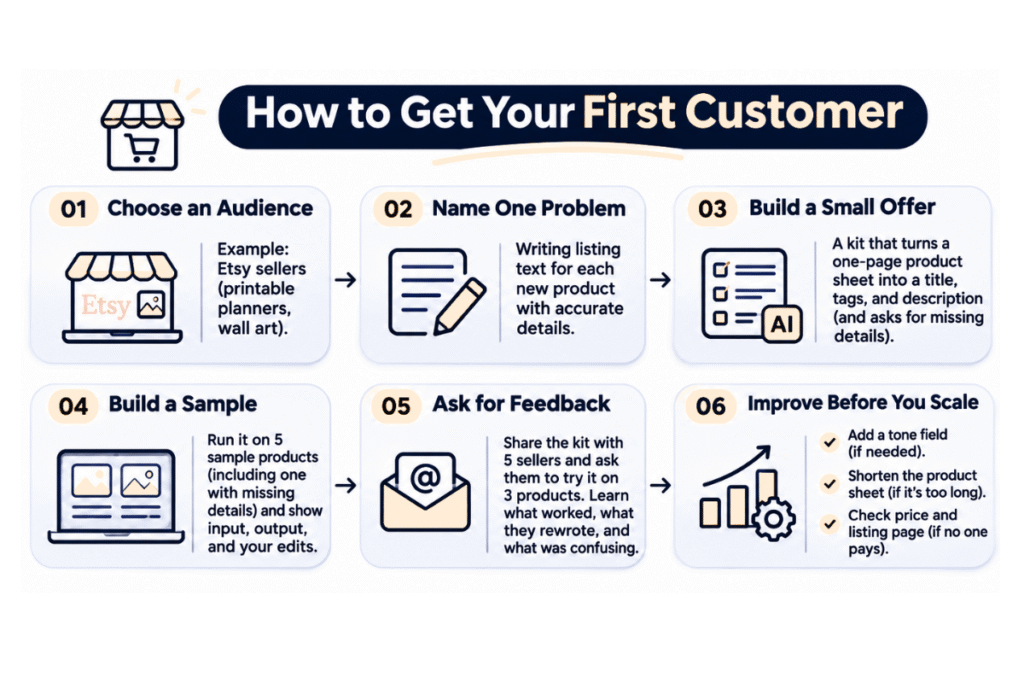
- Choose a specific audience. Example: Etsy sellers of printable planners and wall art. They add new listings often, and every listing needs a title, tags, and a description.
- Name one repetitive problem. Here it is: writing listing text for each new product while keeping the details accurate, such as file type, sizes, and what is included.
- Build a small offer. A kit that takes a one-page product sheet and returns a title, tags, and a description draft. The prompts must ask for any missing detail, such as print sizes, instead of inventing it.
- Build a sample from real test runs. Run the kit on five fictional products, including one with an incomplete sheet. Show the input, the output, and your edits, and keep the failures too, because a preview that shows how the kit handles gaps is more convincing than a perfect run. Do not claim better rankings or sales.
- Ask for feedback on a specific task. Ask five sellers to run the kit on three of their own products and tell you how many drafts they could publish after light edits, what they rewrote, and what confused them. A message could read: “Hi, I am testing a small AI-assisted listing kit for sellers of printable products. It turns a product sheet into a first draft of the title, tags, and description. Could you run it on three of your products and tell me what you had to rewrite? There is no obligation to buy.” Keep it respectful and do not pressure anyone to reply.
- Improve before you spend more. If testers rewrite the tone every time, add a tone field. If they skip the product sheet, shorten it. If people like the kit but nobody pays, check the price, the trust signals, and the listing page before you write more prompts.
Your first sale does not prove you have a business. It tells you what a customer needed. Perhaps buyers found the instructions confusing, or the prompts worked for digital products and gave generic text for physical ones. Fixing that makes the product better than adding another 100 prompts would.
Build your AI side hustle website & save 20% with Hostinger
Red flags: how to avoid “AI earning” scams
India has no shortage of people selling dreams about AI income. Be careful if you see any of these:
- a promise of fixed monthly income, or screenshots of earnings that cannot be verified
- a paid course or prompt bundle sold as the only way to start earning
- a “job” or “client” that asks you to pay a registration, verification, or training fee first
- pressure to recruit others or to decide quickly
- no named person, no real samples, and no way to check past work
Real clients pay you. You should never have to pay to be allowed to work.
FAQ: AI Prompt Engineering
1. Can I make money from creating AI prompts?
Yes, you can make money from creating AI prompts by selling niche prompt packs, building custom prompt systems, or offering AI-assisted services. For example, an Etsy seller could use a tested prompt kit to turn product specifications into listing titles, descriptions, and promotional captions. The opportunity lies in helping customers complete a specific task more efficiently, and bare prompts alone sell for little. Start with one audience, test your prompts on different inputs, and build an offer around a problem people are willing to pay to solve.
2. How much do AI prompt engineers get paid?
There is no fixed salary or freelance rate for AI prompt engineers. Earnings depend on the type of work, experience, customer demand, and project scope. For example, a freelancer might offer a content package for ₹4,000, a chatbot setup for ₹6,000, or a workflow automation project for ₹15,000. These are illustrative pricing examples, not guaranteed earnings or industry averages. Your actual income depends on finding paying customers, delivering reliable results, and accounting for your time, platform fees, and other costs.
3. Can I make $1,000 a day using AI?
Making $1,000 a day using AI is possible for some established businesses, but it is not a realistic expectation for beginners. Selling AI-generated content or prompts does not automatically generate revenue. As a rough check, $1,000 is well above ₹94,000 at recent exchange rates (check today’s rate). A prompt pack priced at ₹499 would need roughly 160 or more sales in a single day to reach that, before fees and other costs. A more sustainable approach is to build a useful offer, test demand, and improve it based on customer feedback.
4. What side hustles can I do with AI?
You can start several AI-powered side hustles, including AI content creation, workflow automation, custom prompt systems, niche prompt packs, chatbot setup, AI image and ad creative services, and AI-assisted SEO content. If you are a beginner, a content service may be easier to start because it requires less technical setup. If you understand a specific industry, a niche prompt pack or custom prompt system may be a better option. Choose one method based on your existing skills, the problem you can solve, and the customers you can reach.
5. Can I sell AI prompts?
Yes, you can sell original AI prompts through marketplaces such as Etsy, Gumroad, and PromptBase, subject to their current rules and seller eligibility requirements. You can also sell custom prompt systems through Fiverr, Upwork, LinkedIn, or direct outreach. A useful product should include more than a collection of prompts: add clear instructions, sample inputs, tested outputs, and a review checklist. Before creating a large bundle, test a smaller version with your target audience. Similar listings show that a category exists, but they do not prove that customers are buying.
Final thoughts
Your first offer does not need to be impressive. A niche prompt kit, a monthly content package, or a simple chatbot is enough to find out whether a specific person will pay for it.
Your next step this week: pick one audience from the list, build a sample with five realistic examples, and show it to five people in that audience. What they say will tell you more than any list of ideas.
