


Quick answer: AI Engineers generally earn more in India, especially at product companies and GenAI startups. But Data Scientists have wider job openings, more stable demand, and a much more forgiving entry point. The right choice depends on what you’re actually good at, not what sounds better in 2026.
For a long time, I just assumed AI Engineering paid more. I said it to people who asked. I wrote it in comments. I operated on it the way you operate on something that feels obviously true: you don’t examine it, you just use it.
And then I watched a friend, three years into data science at a mid-sized fintech in Pune, get a lateral offer for ₹22L. Not AI engineering. Not GenAI. Just senior data science, internal modelling for credit risk. Same tools he’d been using since 2022. SQL, Python, and some scikit-learn.
He took it. He’s not complaining.
That didn’t disprove what I believed. But it made me stop treating this comparison as settled, because it isn’t. Not in 2026, not in India, not with the way hiring has gotten strange and specific.
What Is a Data Scientist?
Someone who uses data to answer business questions. They collect, clean, and analyse data, then help companies make better decisions from it. Why are sales dropping? Which customers are likely to leave, and what does this pattern actually mean?
What Is an AI Engineer?
Someone who builds intelligent systems. Not just analyses actually builds. Recommendation engines, chatbots, fraud detection models, and LLM-powered tools. The focus is on making things work in production, not just on paper.
The Difference in One Line
Data Scientists explain what the data says. AI Engineers build systems that act on it.
Data Scientist vs AI Engineer Salary: Key Differences
| Factor | Data Scientist | AI Engineer |
| Core Skills | SQL, Statistics, Python | Python, Deep Learning, MLOps |
| Daily Work | Analysis, reporting, modelling | Building, deploying, optimising |
| Focus | Business insights | AI-powered products |
| Easier Entry | Yes | Harder |
| Salary Potential | High | Higher |
| Job Openings | More | Growing fast, but fewer |
Data Scientist vs AI Engineer Salary in India (2026): The Actual Numbers
Based on current data from Naukri, LinkedIn Jobs, Glassdoor, and AmbitionBox, here’s what people are realistically getting, not just what job posts claim.
| Experience | Data Scientist | AI Engineer |
| Fresher | ₹6L – ₹12L | ₹6L – ₹14L |
| 3 Years | ₹12L – ₹22L | ₹15L – ₹28L |
| 5+ Years | ₹22L – ₹32L | ₹28L – ₹42L |
Approximate ranges. City, company type, and actual role scope affect this significantly.
One thing worth knowing that most salary articles skip: 2026 has quietly split data science into two salary tiers. Data scientists doing standard ML, dashboards, and analytics sit in one band. Those who’ve added GenAI, LLMs, or MLOps skills earn 25–40% more, with the same years of experience, same title on paper. The title is the same. The pay is not.
Why “AI Pays More” Is True But Also Incomplete
Fresh AI engineers at real product companies are getting ₹10L to ₹14L. Data science freshers at comparable companies are getting ₹6L to ₹12L. That gap exists, I’m not going to pretend otherwise.
But the comparison usually skips something: the number of those roles is very different.
AI engineering jobs at that salary level cluster in maybe twenty companies in India that are actually building AI infrastructure, not wrapping OpenAI APIs and calling it a product, but training, fine-tuning, and deploying at scale. PhonePe’s risk systems. Swiggy’s ML infra. Zepto. A handful of funded startups. That’s a thin market.
Data science openings are spread across industries. Banks, insurance, e-commerce, healthcare, and FMCG. The analytics layer of Indian business is thick. It’s not glamorous, but it’s stable in a way that matters when you’re three years in, you have rent and maybe a loan.
“AI pays more” is true, just as “Mumbai pays more than Nagpur” is true. Accurate, but not the whole picture.
Best Paying Cities for AI and Data Roles in India
Bangalore is still where the serious product company money is for both roles. If you’re targeting ₹20L+ in AI engineering, this is where the density of companies that actually pay that exists.
Hyderabad has grown fast, especially for data roles in pharma, fintech, and big tech campuses. Slightly lower than Bangalore on average, but not dramatically so.
Pune has a strong BFSI and IT services presence. Data science roles are plentiful. AI engineering is thinner but picking up, especially around newer tech setups.
Gurgaon leans more towards analytics, consulting-adjacent data work, and funded startups.
Remote roles are real and can pay Bangalore rates. Competition for them is higher than most people expect, though.
Which Companies Commonly Hire for These Roles in India
AI Engineering roles are commonly found at PhonePe, Swiggy, Zepto, Razorpay, Meesho, CRED, Google India, Microsoft India, and a growing number of well-funded GenAI startups.
Data Science roles are commonly found at HDFC Bank, ICICI Bank, Bajaj Finserv, Amazon India, Flipkart, Zomato, Wipro Analytics, Infosys, and many mid-to-large companies across BFSI, healthcare, and e-commerce.
The Data Science hiring pool is generally wider. This pattern consistently shows up across major job platforms like Naukri and LinkedIn Jobs.
What About ML Engineers? Where Do They Fit?

People often search “Data Scientist vs AI Engineer vs ML Engineer” because the titles genuinely overlap, and nobody uses them consistently.
A Data Scientist focuses on analysis, insights, and model building for business decisions. An ML Engineer builds and optimises ML systems closer to software engineering, less on interpretation. An AI Engineer is the broader term, increasingly used for people working with LLMs, GenAI, and AI product development.
In India, a job post saying “AI Engineer” at a services company might actually be an MLOps role. A “Data Scientist” at a startup might be doing work that touches all three. Read the JD for what they’re asking you to build, not just the title at the top.
Five Career Paths: What Actually Happens Inside Each
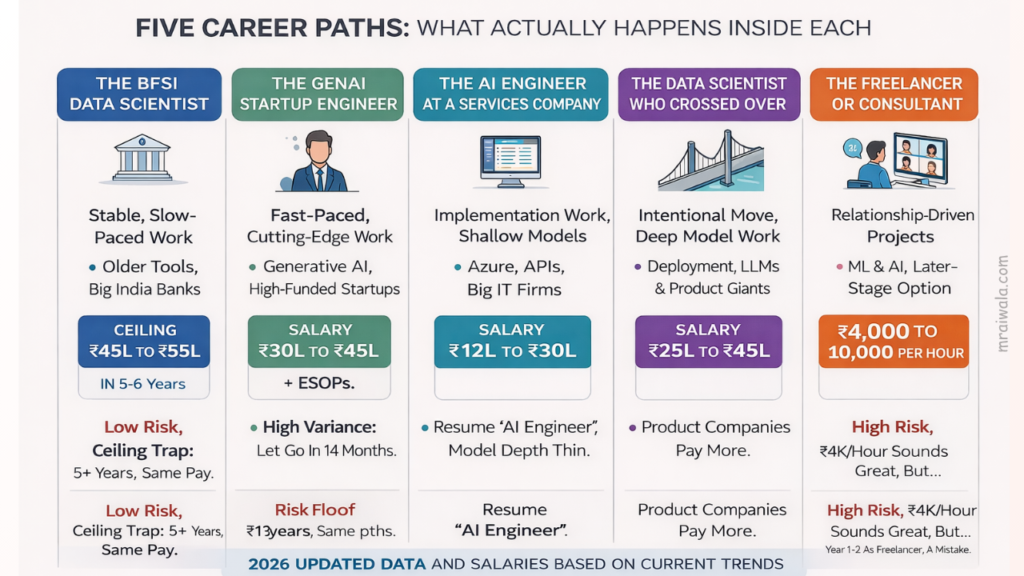
The BFSI Data Scientist
Banks and insurance companies hire a lot of data scientists. The work is stable, including credit scoring, fraud detection, and customer segmentation. Tools are often older, sometimes SAS, sometimes internal platforms nobody outside the company has heard of.
The ceiling is real, though. Most people in this track top out around ₹25L to ₹30L in five or six years unless they move into management or leave for another company. The ones who stay longer waiting for a jump that doesn’t come internally, that’s a pattern I’ve seen more than once. It’s a good system if you know what you’re getting into. It becomes a trap if you don’t notice the ceiling until year four.
The GenAI Startup Engineer
The work is genuinely interesting. RAG implementations, fine-tuning, LLM tooling. Salaries of ₹18L to ₹28L with ESOPs are real. So is the risk.
A significant chunk of these companies doesn’t have sustainable revenue yet. I know people who joined well-funded GenAI startups in 2024 at decent packages and were let go within fourteen months when the runway thinned. The equity didn’t help. One of them is back at a services company now doing work he’d left behind. He’s not bitter about it, just more careful with the next offer.
High variance, genuinely. If you take this route, be honest with yourself about whether you can handle six months of uncertainty on the other side.
The AI Engineer at a Services Company
This is the one nobody is fully honest about.
A large portion of “AI engineer” roles at TCS, Infosys, Wipro, Accenture’s delivery centres are implementation work, configuring Azure ML, building pipelines, integrating APIs, and occasionally retraining a model on client data. The salary sits at ₹6L to ₹20L depending on experience and band. Freshers often start at ₹6L–₹8L despite the AI title.
After three years here, your resume says “AI Engineer,” but the actual model depth is thin. Product companies figure this out fast in interviews, not because you lied, but because the work you were doing didn’t require what they’re asking. The gap between services AI work and product AI work is wider than it looks from inside the services company.
The Data Scientist Who Crossed Over
This is probably the most common career path that nobody draws clearly on a diagram.
Someone spends two or three years doing real data science clustering, prediction, Python modelling, and then deliberately moves into AI engineering by adding deep learning, deployment, and LLM work. The salary jump when they make this move is usually ₹4L to ₹8L, sometimes more if they’ve actually shipped something they can walk through in an interview.
The people who don’t make it across are the ones who did the certification and skipped the building part. One Coursera certificate and a Kaggle notebook are not the same as deploying something that runs in production. Interviews for AI engineering roles at product companies expose this difference quickly. It’s not harsh, just real.
The Freelancer or Consultant
Exists, but smaller than LinkedIn makes it look. The actual market for individual AI consultants in India is relationship-driven. ₹3,000 to ₹8,000 per hour for serious ML or AI work is possible if you have the right connections and track record. Data analytics consulting is steadier, but rates are lower.
Trying this in year one or two of your career is almost always a mistake. Not because the skills aren’t there, but because clients in India want proof, not a portfolio website, actual work they can verify. This is a later-stage option.
Here’s the compression.
Maximum salary, willing to accept variance → AI engineering at a product company.
Stable career, options across industries, sleep at night → data science.
You cannot fully optimise for both. Pick one as your primary direction.
Best Roadmap in 2026
Path A: Data Science First, AI Later
Python → SQL → Statistics basics → Pandas, NumPy → ML fundamentals → 2–3 real projects → Data science job → Deep learning and deployment → AI engineering when ready.
Most working AI engineers in India actually took something close to this route. The time in data science isn’t a detour. It’s the foundation.
Path B: Direct AI Engineering
Advanced Python → Data structures basics → ML and Deep Learning → PyTorch or TensorFlow → APIs and deployment → LLM projects → Apply.
Works if you already code reasonably well. If you’re starting from scratch, Path A gets you to your first job faster.
Simple test: can you write a working Python script without googling basic syntax? If yes, Path B is worth attempting. If not, start with Path A and don’t feel bad about it.
If You Are a Beginner in 2026, Choose What?
Data Science, if you think in terms of patterns and business problems, if you look at data and ask “why is this happening” before asking “how do I automate this.” You can build something useful within six months with SQL, Python, and basic ML.
AI Engineering if you already code and find systems, model architecture, and deployment more interesting than interpretation. Be honest about this one. The gap between course content and what product company AI roles actually require is wider than in data science.
For most people: start with data science, get a job, build domain knowledge, and move into AI when the timing makes sense. Not the exciting answer. The one that actually works.
What the Skill Gap Looks Like in Real Interviews
AI engineering rejections usually happen not because someone can’t explain the model, but because they can. It’s because they can’t talk about what happens in production. Latency. Cost. Model drift over time. What the system does when it gets an input it wasn’t trained for. That’s the gap between studying AI and having built something with it.
Data science rejections tend to come from the other direction. Strong on Python and ML, shaky on the business layer. Can build the model, can’t explain what the output actually means for a decision someone needs to make on Monday morning.
Neither gap shows up on a course syllabus. Both are fixable with real project work.
AI vs Data Science Questions That Actually Matter If You Want to Make the Smarter Career Move
1. AI vs Data Science Salary: Which Pays More in India?
AI usually pays more at the higher end, especially in product companies, GenAI startups, and engineering-heavy roles. Data Science still offers strong salaries, but AI often has the bigger ceiling. If maximizing income is your top priority, AI usually has the advantage.
2. Which Is Better in India: AI or Data Science?
For most people in India, Data Science is a better starting choice. It has broader hiring demand and a faster path to your first job. AI can be stronger long-term for higher upside, but Data Science is usually the more practical first move.
3. Which Is Easier to Enter: Data Science or AI Engineering?
Data Science is generally easier to enter. More openings, clearer learning path, and lower entry-level expectations. AI Engineering usually requires stronger coding and real deployment skills. If you want the easier entry path, Data Science wins.
4. Can AI Replace Data Science Careers?
Not fully. AI can automate repetitive analytics and basic modeling tasks, but companies still need people who understand business problems, messy data, experimentation, and decision-making. Data Science roles will change, not disappear.
5. Which Has the Better Future: AI or Data Science?
AI likely has faster growth and higher upside. Data Science likely stays broader and more stable. The strongest future path is combining both: Data Science fundamentals with AI skills. That mix gives the best long-term advantage.
Final Verdict
| Goal | Choose |
| Highest salary potential | AI Engineering |
| More stable job market | Data Science |
| Easier entry as a beginner | Data Science |
| Higher upside long-term growth | AI Engineering |
| Best starting path for most people | Data Science → then AI |
Job security and options across industries → Data Science.
Highest salary ceiling, willing to work harder for it → AI Engineering.
Beginner, unsure → Start with Data Science. Move into AI when you’re ready.
Already in data science and want to earn more without switching careers → Add GenAI or MLOps to your current profile. The gap between a generalist DS and an AI-skilled DS is now large enough that it’s the fastest salary lever available inside the field.
You have two tabs open right now. One is a data science job posting at a mid-sized company; the role looks manageable, the salary is decent, and you’ve done similar work before. The other is an AI engineering role that’s slightly above your current level. The JD has three things you don’t fully know yet: the company looks interesting, and the salary is higher.
You’ve been looking at both tabs for a while.
Read This Next 📌
AI Engineer vs Data Scientist (2026): Salary, Skills & Demand
AI Automation Engineer: Build $1K/Month Systems in 90 Days (No Experience)
